Aquarium KH and GH Guide: Hardness, Minerals & pH Stability
Introduction
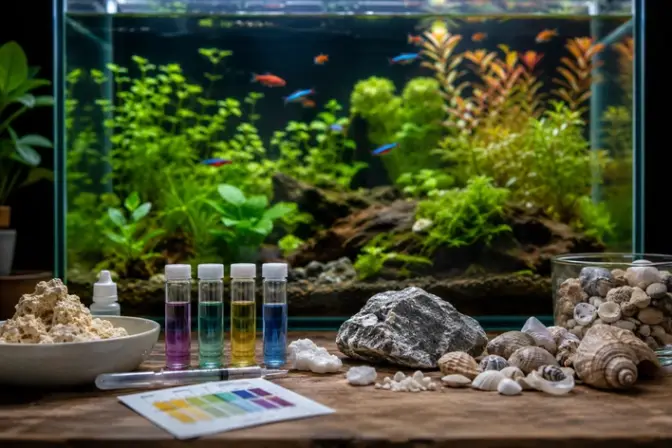
Aquarium KH and GH are two of the most important water parameters for freshwater stability, but they are also two of the most confusing. KH controls buffering and helps keep pH stable. GH describes dissolved minerals, mainly calcium and magnesium, which matter for fish, shrimp, snails, plants, and overall biological function.
Many aquarium problems are blamed on pH, but the real cause is often KH or GH. A pH crash usually has a buffering problem behind it. Shrimp molting issues often involve mineral balance. Snail shell erosion can be connected to soft, acidic, low-mineral water. Plant deficiencies may appear when calcium or magnesium is too low. Hardscape and tap water can quietly change both KH and GH over time.
This guide explains what KH and GH mean, how they differ, how they affect pH stability, how they influence livestock and plants, and how to adjust them safely. It sits below the larger Aquarium Water Guide and connects directly to the Aquarium Water Parameters Guide and Aquarium pH Guide.
The most important rule is simple: do not change KH or GH suddenly in a stocked aquarium. Fish, shrimp, snails, plants, and beneficial bacteria need stable conditions. The goal is not to chase random hardness numbers. The goal is to match your water chemistry to your aquarium’s livestock, plants, substrate, hardscape, and maintenance routine.
Quick Answer
- KH means carbonate hardness or alkalinity in aquarium use; it helps buffer pH.
- GH means general hardness; it mainly reflects calcium and magnesium minerals.
- Low KH can make pH unstable and increase pH crash risk.
- High KH makes pH harder to lower and often supports alkaline water.
- Low GH can cause mineral problems for shrimp, snails, fish, and plants.
- High GH may be unsuitable for soft-water species but useful for hard-water livestock.
- KH and GH are different; a tank can have high GH and low KH, or high KH and moderate GH.
- RO water usually needs remineralization before aquarium use.
- Rocks, shells, coral, limestone, aragonite, and crushed coral can raise hardness and buffering.
- Active soil can lower KH, especially in aquascapes and shrimp tanks.
What you’ll learn in this lesson
- What KH means in freshwater aquariums
- What GH means and why minerals matter
- The difference between KH and GH
- How KH affects pH stability and pH crashes
- How GH affects fish, shrimp, snails, and plants
- Why tap water, RO water, rocks, soil, and substrate change hardness
- How to raise or lower KH and GH safely
- How to choose livestock for soft or hard water
- How to troubleshoot KH and GH problems without causing parameter shock
What Are KH and GH?
KH and GH are hardness-related water parameters, but they do not measure the same thing. KH describes buffering capacity. GH describes mineral hardness. Both are important, but they affect the aquarium in different ways.
KH is closely connected to pH stability. If KH is very low, pH can move more easily. This can be useful in specialized soft-water aquariums, but it can also make pH more vulnerable to sudden drops. If KH is high, pH is usually more resistant to change and often harder to lower.
GH is about minerals, especially calcium and magnesium. These minerals matter for fish osmoregulation, shrimp molting, snail shell health, plant nutrition, and general biological function. A tank can have stable pH but still have GH that is too low or too high for certain livestock.
In simple terms: KH protects pH stability. GH supports mineral balance.
KH Explained: Carbonate Hardness and Buffering
KH stands for carbonate hardness. In aquarium practice, it is often used as a practical measure of alkalinity or buffering capacity. KH helps water resist sudden pH changes. This is why KH is one of the most important values to test when pH is unstable.
When KH is low, there is less buffering capacity. Organic acids, CO₂, active soil, biological processes, and water changes can move pH more easily. When KH is higher, pH usually becomes more stable, but it also becomes more difficult to lower.
This is why pH-down products often fail in high-KH water. The pH may drop temporarily, but the buffering system pushes it back up. That rebound can create instability and stress livestock more than leaving the pH stable.
What KH tells you
- How resistant your pH is to sudden change
- Whether your tank may be vulnerable to pH crashes
- Why pH may rebound after chemical adjustment
- Whether active soil or RO water is reducing buffering
- Whether water changes may cause pH swings
- Why some aquariums naturally stay alkaline
For pH-specific context, read the Aquarium pH Guide, Aquarium pH Too Low, Aquarium pH Too High, and Stable Aquarium pH.
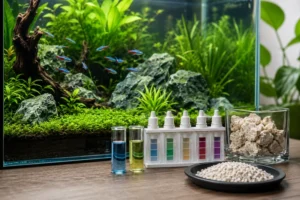
GH Explained: General Hardness and Minerals
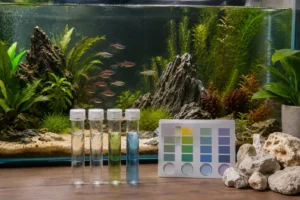
GH stands for general hardness. It mainly reflects dissolved calcium and magnesium in the water. GH does not buffer pH in the same way KH does. Instead, GH tells you about mineral content.
Calcium and magnesium matter in different ways. Fish use minerals for osmoregulation and normal physiological function. Shrimp need mineral stability for molting. Snails need calcium-rich conditions for shell health. Aquarium plants use calcium and magnesium as essential nutrients.
Very low GH can create problems in tanks that need mineral-rich water. Very high GH can stress soft-water species or make some specialized setups harder to manage. As always, the best GH depends on livestock and tank design.
What GH tells you
- Whether water is mineral-poor or mineral-rich
- Whether shrimp have enough mineral support for molting
- Whether snails have enough mineral content for shell health
- Whether fish are being kept in water that matches their natural preference
- Whether RO water has been remineralized properly
- Whether rocks, substrate, or additives are increasing hardness
KH vs GH: The Key Difference
KH and GH are often confused because both are related to water hardness. But they do different jobs. KH is about buffering and pH stability. GH is about mineral content.
This difference matters because you can have one value high and the other low. For example, some water may have high GH from calcium and magnesium but relatively low KH. Another water source may have strong carbonate buffering but not extremely high GH. This is why testing only one value does not tell the full story.
| Parameter | Main Meaning | Main Effect | Most Important For |
|---|---|---|---|
| KH | Carbonate hardness / buffering | pH stability | Preventing pH swings and crashes |
| GH | General hardness / minerals | Calcium and magnesium availability | Fish, shrimp, snails, plants |
| pH | Acidity or alkalinity | Livestock suitability and ammonia context | Overall water chemistry |
The practical rule is simple: test KH when pH is unstable, and test GH when livestock or plants may have mineral-related issues.
Why KH Matters for pH Stability
KH matters because it helps prevent sudden pH movement. In low-KH water, pH can drop more easily from CO₂, organic acids, active soil, biological processes, or inconsistent source water. In high-KH water, pH usually resists movement and often stays alkaline.
A pH crash often happens when buffering capacity is too low or has been exhausted. The pH drops quickly, and livestock may show stress. Fish may become inactive, hide, breathe rapidly, or clamp fins. Shrimp may become weak or die after water changes if the parameter shift is too strong.
Low KH is not automatically wrong. Many aquascapes, blackwater tanks, and Caridina shrimp setups intentionally use low-KH water. But low KH gives less margin for mistakes. It requires consistency, suitable livestock, and careful water preparation.
High KH is not automatically wrong either. It can be excellent for livebearers, snails, and hard-water species. But it makes soft-water goals harder and pH reduction more difficult.
Why GH Matters for Fish, Shrimp, Snails, and Plants
GH matters because freshwater animals and plants are not only living in water; they are living in a mineral environment. Calcium and magnesium are not optional details. They affect biology, growth, shells, molting, and plant nutrition.
Fish and GH
Different fish are adapted to different mineral levels. Soft-water fish often come from low-mineral environments. Hard-water fish are more comfortable in mineral-rich water. Many captive-bred community fish are adaptable, but extreme mismatch can still create long-term stress.
Shrimp and GH
Shrimp need stable mineral content for molting and shell formation. Neocaridina shrimp often tolerate harder, more alkaline water better than many Caridina shrimp. Caridina systems often use RO water with specialized remineralization and active soil. These setups should not be managed like standard community tanks.
Snails and GH
Snails often benefit from mineral-rich water. Low pH, low KH, and low GH can contribute to shell erosion or poor shell development. If snails show shell damage, test pH, KH, GH, and calcium availability instead of assuming food alone is the issue.
Plants and GH
Aquarium plants use calcium and magnesium as nutrients. Low or imbalanced GH can contribute to deficiency-like symptoms, especially when light, CO₂, and macronutrients are otherwise strong. Plant problems should always be interpreted together with CO₂, light, nitrate, phosphate, potassium, iron, and general maintenance.
For plant nutrition, continue with Macronutrients for Aquarium Plants and Micronutrients for Aquarium Plants.
KH and GH in Soft-Water Aquariums
Soft-water aquariums have low mineral content and often lower buffering. They can be beautiful and biologically appropriate for many fish, shrimp, plants, and blackwater-inspired systems. But they require more attention to stability.
In soft water, pH may be easier to move because KH is often low. Active soil, driftwood, botanicals, CO₂, and organic acids may influence pH more strongly than they would in harder water. This is not necessarily bad. It simply means the system must be planned intentionally.
Soft-water aquariums are often best for livestock that naturally prefer lower mineral content. Trying to keep hard-water fish, snails, or shrimp in very soft water can create health and stability issues.
KH and GH in Hard-Water Aquariums
Hard-water aquariums have more dissolved minerals and often stronger buffering. They are common in areas with limestone-rich geology or hard tap water. Hard water can be excellent for livebearers, many snails, some cichlids, and other species that prefer mineral-rich conditions.
High KH usually keeps pH stable and alkaline. This can be helpful, but it also means pH is harder to lower. If you try to keep soft-water species in strongly buffered hard water, repeated pH-down corrections may create swings without solving the underlying mismatch.
For many aquarists, the easiest long-term solution is choosing livestock that match the tap water. This reduces complexity, improves stability, and makes water changes easier.
Tap Water, RO Water, and Remineralization
Your source water determines the starting point for KH and GH. Tap water may be naturally soft, hard, acidic, alkaline, low in nitrate, or high in nitrate depending on the local supply. Reverse osmosis water is very low in dissolved minerals and usually needs remineralization before aquarium use.
RO water is not automatically safe just because it is pure. Pure RO water lacks stable mineral content and buffering. Fish, shrimp, snails, plants, and beneficial bacteria still need appropriate minerals and water chemistry. The correct approach is to rebuild GH and, when needed, KH according to the aquarium’s goal.
If you use RO water, consistency is critical. Prepare water the same way each time. Test KH and GH before adding it to the tank. Sudden changes in mineral content can shock livestock, especially shrimp.
Source water testing checklist
- Tap water pH immediately after drawing
- Tap water pH after resting
- Tap water KH
- Tap water GH
- Tap water nitrate
- Prepared RO-water KH
- Prepared RO-water GH
- Temperature before water changes
For the wider testing framework, read the Aquarium Water Parameters Guide.
Rocks, Substrate, Soil, and Hardscape Effects
Hardscape and substrate can change KH and GH over time. This is especially important in aquascapes where large amounts of rock, soil, sand, or decorative materials are used.
Limestone, coral, shells, aragonite, crushed coral, coral sand, and some carbonate-rich stones can raise KH, GH, or pH. Active aquarium soil often lowers KH and pH, especially when new. Inert sand should not significantly change hardness if it is truly inert.
If KH or GH rises after adding hardscape, something in the aquarium may be dissolving minerals into the water. If KH drops after adding active soil, the soil may be doing exactly what it was designed to do.
| Material | Possible Effect | Best Use |
|---|---|---|
| Limestone | Raises KH, GH, and pH | Hard-water setups |
| Crushed coral | Raises buffering and alkalinity | Snail, livebearer, hard-water tanks |
| Aragonite | Raises hardness and alkalinity | Alkaline systems, not soft-water aquascapes |
| Shells and coral pieces | Can dissolve and raise hardness | Only when mineral increase is desired |
| Active soil | Lowers KH and pH | Aquascapes, soft-water plants, Caridina setups |
| Inert sand | Should not change KH/GH significantly | Neutral community or planted tanks |
| Driftwood | May gently acidify low-KH water | Soft-water and natural-style setups |
For hardscape planning, read the Aquarium Rock Guide, Aquarium Sand Guide, Aquarium Soil Guide, and Aquarium Driftwood Guide.
How to Test KH and GH Correctly
KH and GH are usually tested with liquid titration kits or test strips. Liquid kits are often more useful when you need better precision. Whatever test you use, follow the instructions carefully and record results over time.
One test gives you a snapshot. Trends show whether your water is stable. If KH slowly rises after adding stone, the hardscape may be changing the water. If KH drops after adding active soil, the substrate may be buffering the system downward. If GH changes after water changes, source water or remineralization may be inconsistent.
When to test KH and GH
- Before choosing sensitive fish or shrimp
- Before using RO water
- After switching tap water source or mixing ratios
- When pH is unstable
- When shrimp have molting issues
- When snails show shell erosion
- When plants show possible calcium or magnesium issues
- After adding new rocks, substrate, soil, shells, or coral
- Before and after water changes if parameters swing
Always test KH together with pH when pH stability is the issue. Always test GH when mineral balance or livestock suitability is the issue.
How to Raise KH Safely
Raising KH increases buffering and can make pH more stable. This may be useful when pH keeps dropping, KH is too low for your livestock, or you are maintaining hard-water species that need stronger alkalinity.
Raise KH gradually. Sudden jumps can shock fish and shrimp, especially if pH rises at the same time. In stocked tanks, slow controlled change is safer than quick correction.
Ways to raise KH
- Use appropriate carbonate buffering minerals.
- Use crushed coral or carbonate media carefully.
- Mix with harder tap water if suitable.
- Use a remineralizer that raises KH when preparing RO water.
- Choose hardscape or substrate that supports alkaline water when that is the goal.
Do not raise KH blindly. First decide whether your livestock actually need higher KH. Some soft-water and active-soil systems are intentionally low-KH.
How to Lower KH Safely
Lowering KH is usually done when the aquarium needs softer, less buffered water. This may be useful for soft-water fish, blackwater systems, some aquascapes, or Caridina shrimp setups. It should be done gradually and intentionally.
The safest way to lower KH is usually source-water management. That often means mixing tap water with RO water or using remineralized RO water. Quick pH-down products are not the same as safely reducing KH.
Ways to lower KH
- Mix tap water with RO water gradually.
- Use properly remineralized RO water.
- Use active soil for setups where low KH is intended.
- Remove crushed coral, shells, limestone, coral sand, or aragonite if they are unwanted.
- Avoid carbonate-rich rocks in soft-water aquascapes.
Do not drop KH suddenly in a stocked tank. Lower KH also means less buffering, so pH stability must be managed carefully.
How to Raise GH Safely
Raising GH increases mineral content, especially calcium and magnesium. This may be needed when using RO water, keeping shrimp or snails, supporting hard-water fish, or correcting very soft water that lacks essential minerals.
Use a suitable remineralizer or mineral source designed for your goal. Some products raise only GH, while others raise both GH and KH. This distinction matters. A shrimp remineralizer for Caridina may behave differently from a remineralizer for Neocaridina or community tanks.
Ways to raise GH
- Use a GH remineralizer for RO water.
- Use calcium and magnesium supplements when appropriate.
- Mix with harder tap water if suitable.
- Use mineral sources designed for shrimp or snail systems.
- Choose livestock that match naturally mineral-rich water.
Raise GH gradually. Sudden mineral changes can stress shrimp and fish even if the final number is technically suitable.
How to Lower GH Safely
Lowering GH means reducing dissolved mineral concentration. This is usually done for soft-water fish, sensitive plants, certain aquascapes, or specialized shrimp setups. The most reliable method is dilution with lower-mineral water, usually RO water.
Do not try to lower GH with random chemicals. Manage source water. Test tap water, test RO water, and prepare consistent replacement water. If rocks, substrate, or shells keep raising GH, remove the source.
Ways to lower GH
- Use RO water mixed with tap water.
- Use remineralized RO water with a lower target GH.
- Remove mineral-releasing rocks or substrates.
- Avoid shells, coral, aragonite, and crushed coral in soft-water tanks.
- Make changes slowly through regular water changes.
Lower GH gradually, especially in shrimp tanks. Sudden GH changes can interfere with molting and general stability.
KH and GH Troubleshooting Table
Use this table to connect common KH and GH patterns with likely causes and first actions.
| Problem | Likely Cause | First Action |
|---|---|---|
| pH keeps dropping | Low KH, organic buildup, active soil | Test KH and review maintenance/substrate |
| pH keeps rising | High KH, carbonate rocks, hard tap water | Test KH/GH and inspect materials |
| pH-down does not hold | KH buffering pushes pH back up | Address source water and KH |
| Shrimp molting problems | GH/KH instability or mineral mismatch | Test GH, KH, pH, source water |
| Snail shell erosion | Low pH, low KH, low GH, low calcium | Improve mineral stability gradually |
| Plants show calcium/magnesium issues | Low or imbalanced GH | Review GH and nutrient dosing |
| GH rises over time | Rocks, substrate, additives, hard water | Test source water and inspect hardscape |
| KH drops after adding soil | Active soil lowering buffering | Confirm soil behavior and match livestock |
| RO tank unstable | Insufficient remineralization | Prepare consistent GH/KH before water changes |
Common KH and GH Mistakes
KH and GH problems often come from changing water chemistry without understanding the goal. Avoid these common mistakes.
- Confusing KH and GH: KH buffers pH, while GH measures minerals.
- Testing pH without KH: pH stability cannot be understood properly without buffering context.
- Using RO water without remineralization: pure RO water lacks stable minerals and buffering.
- Changing KH or GH suddenly: fast mineral shifts can stress fish and shrimp.
- Fighting active soil with pH-up products: active soil is often designed to lower KH and pH.
- Using carbonate rocks in soft-water tanks: they may raise KH, GH, and pH over time.
- Ignoring tap water: source water often explains hardness problems.
- Choosing livestock before testing water: it is easier to match animals to stable water than force water to unsuitable animals.
- Only chasing ideal numbers: stability and species suitability matter more than generic charts.
KH and GH Checklist
Use this checklist when setting up a new aquarium, choosing livestock, using RO water, or troubleshooting pH and mineral problems.
- Test tap water KH.
- Test tap water GH.
- Test aquarium KH.
- Test aquarium GH.
- Compare KH/GH before and after water changes.
- Check whether pH is stable.
- Check whether rocks or substrate may raise hardness.
- Check whether active soil is lowering KH.
- Remineralize RO water consistently.
- Choose livestock that match your stable water.
- Adjust KH or GH gradually, not suddenly.
- Record trends instead of reacting to one result.
Quick Takeaways
- KH and GH are different water parameters.
- KH controls buffering and helps keep pH stable.
- GH reflects minerals, mainly calcium and magnesium.
- Low KH can increase pH swing and pH crash risk.
- High KH makes pH harder to lower and often supports alkaline water.
- Low GH can create mineral problems for shrimp, snails, fish, and plants.
- High GH may be unsuitable for soft-water species but useful for hard-water livestock.
- RO water usually needs remineralization before aquarium use.
- Rocks, coral, shells, aragonite, and crushed coral can raise hardness.
- Active soil can lower KH and pH.
- Adjust KH and GH slowly in stocked aquariums.
- Choose livestock that match your stable water whenever possible.
Conclusion
Aquarium KH and GH are essential for freshwater stability. KH helps explain pH behavior, buffering, pH swings, and pH crashes. GH explains mineral balance for fish, shrimp, snails, and plants. Together, they tell you far more about your water than pH alone.
The safest strategy is to understand your source water, choose livestock that match it, and make changes gradually when adjustment is truly needed. Do not chase numbers without a goal. A stable aquarium with suitable KH and GH is easier to maintain, safer for livestock, and more predictable over time.
From here, continue with the Aquarium Water Parameters Guide, the Aquarium pH Guide, or deeper articles like KH Explained, GH Explained, and KH vs GH once those are published.
Next step:
Test your tap water and aquarium water for KH and GH. If pH is unstable, focus on KH. If shrimp, snails, fish, or plants show mineral-related problems, focus on GH and consistency.
💬 Join the Conversation
Tag us on Instagram @AquariumLesson — we’d love to see your water test results, shrimp tanks, planted aquariums, and hardscape setups.
👉 Which value confuses you more: KH, GH, or pH?
FAQ
What is KH in an aquarium?
KH stands for carbonate hardness. In aquarium use, it describes buffering capacity and helps explain how stable pH is. Low KH can make pH easier to move, while high KH usually makes pH more resistant to change.
What is GH in an aquarium?
GH stands for general hardness. It mainly reflects dissolved calcium and magnesium minerals. GH matters for fish, shrimp, snails, plants, molting, shell health, and mineral balance.
What is the difference between KH and GH?
KH measures buffering capacity and affects pH stability. GH measures mineral hardness, mainly calcium and magnesium. KH is about pH control; GH is about mineral content.
Does KH affect pH?
Yes. KH helps buffer pH and prevents sudden changes. Low KH can make pH unstable, while high KH can make pH harder to lower.
Does GH affect pH?
GH does not buffer pH in the same way KH does. GH mainly reflects minerals such as calcium and magnesium. However, natural hard water often has both higher GH and higher KH, so the values can be related in some source waters.
What KH is best for aquariums?
The best KH depends on the aquarium. Soft-water aquascapes and some shrimp setups may use low KH, while livebearers, snails, and hard-water fish often do better with more buffering. Stability and livestock suitability matter more than one universal number.
What GH is best for aquariums?
The best GH depends on your livestock and plants. Shrimp, snails, hard-water fish, soft-water fish, and planted aquariums can all have different mineral needs. Test your water and match it to the species you keep.
Can low KH cause a pH crash?
Yes. Very low KH means weak buffering, which can increase the risk of sudden pH drops. Low KH is not always bad, but it must be managed carefully with suitable livestock and consistent water preparation.
How do I raise GH without raising KH?
Use a GH-only remineralizer or mineral source designed to raise calcium and magnesium without adding carbonate buffering. Check the product label carefully because some remineralizers raise both GH and KH.
Do I need to remineralize RO water?
Yes, in most aquarium uses. Pure RO water has very low mineral content and buffering. Fish, shrimp, snails, plants, and bacteria usually need appropriate GH and sometimes KH depending on the setup.
Lesson completed!
You've finished this lesson. Keep building your aquarium knowledge, one lesson at a time.
Continue learning →New to AquariumLesson? Start with our complete Aquarium Lessons Hub or return to the homepage at AquariumLesson.com.
References
- FAO. Water Quality and Fish Health.
- FAO. Water Quality Criteria for European Freshwater Fish.
- Auburn University. Water Quality Management in Pond Fish Culture.
- North Central Regional Aquaculture Center. An Introduction to Water Chemistry in Freshwater Aquaculture.
- AquariumLesson. Aquarium Water Parameters Guide.