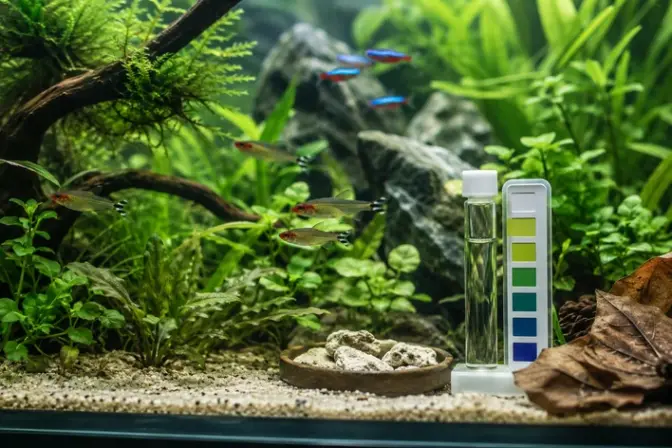
Stable Aquarium pH: How to Prevent Swings, Crashes & Fish Stress
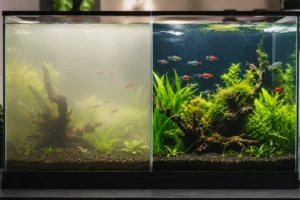
Stable aquarium pH is more important than chasing a perfect number. Many freshwater fish, shrimp, snails, and aquarium plants can adapt to a reasonable pH range, but they struggle when pH changes suddenly. A tank with stable pH 7.6 can be healthier than a tank that jumps between 6.6 and 7.8 every week.
pH stability is not only about the pH value itself. It depends on KH, source water, CO₂, substrate, rocks, driftwood, water changes, organic waste, and livestock choice. If you keep adjusting pH without understanding these factors, you may create the very instability you are trying to fix.
This guide explains how to keep aquarium pH stable, why pH swings happen, how KH prevents crashes, how CO₂ affects planted tanks, and how to make safe corrections without shocking fish or shrimp. For the complete pH foundation, read the Aquarium pH Guide. For the full water-quality system, start with the Aquarium Water Guide.
Quick Answer
- Stable pH matters more than perfect pH for most freshwater aquariums.
- KH is the main buffering parameter that helps prevent pH swings.
- Low KH can make pH unstable and increase the risk of pH crashes.
- CO₂ injection can create daily pH movement in planted tanks.
- Water changes can cause pH swings if source water differs from tank water.
- Active soil can lower pH and KH, especially when new.
- Carbonate rocks and substrates can raise pH over time.
- Avoid repeated pH-up or pH-down corrections without solving the cause.
The goal is not to freeze pH forever. The goal is to avoid uncontrolled, stressful swings and create predictable water chemistry that matches your livestock and aquarium style.
What you’ll learn in this lesson
- Why pH stability matters more than a perfect pH value
- How KH buffers aquarium water and prevents sudden drops
- Why pH swings happen after water changes
- How CO₂ affects pH in planted aquariums
- How active soil, rocks, substrate, driftwood, and tap water influence pH
- How to recognize unstable pH and pH crashes
- How to keep pH stable for fish, shrimp, snails, and plants
- Which mistakes make pH instability worse
- How to build a stable long-term pH routine
Why Stable Aquarium pH Matters
Freshwater livestock can often tolerate a wider pH range than beginners expect, especially when the pH is stable and the species are suitable for the water. What causes stress is sudden change. Fish, shrimp, snails, and beneficial bacteria all need time to adapt to water chemistry.
A pH swing can affect osmoregulation, respiration, stress response, molting in shrimp, bacterial activity, and overall livestock comfort. Even if the final pH value looks acceptable, the speed of the change can be harmful.
This is why “perfect pH” is often the wrong goal. A stable aquarium should not need constant correction. If you have to adjust pH every few days, the tank is not stable. Something in the system is pushing pH up, pulling it down, or allowing it to move too easily.
The best approach is to understand the system behind pH: KH, GH, CO₂, source water, substrate, hardscape, organic waste, and water-change routine.
Stable pH vs Perfect pH
A perfect pH number does not exist for all aquariums. A blackwater tank, a livebearer tank, a high-tech aquascape, a Neocaridina shrimp tank, and a Caridina shrimp setup may all need different water chemistry. The same pH value can be ideal in one tank and unsuitable in another.
Instead of asking, “What is the perfect pH?” ask:
- Is the pH stable over time?
- Does this pH suit my livestock?
- Is KH high enough to prevent sudden crashes?
- Does my tap water match my aquarium goals?
- Is CO₂ creating controlled daily movement?
- Are rocks, soil, substrate, or driftwood changing the water?
- Are ammonia and nitrite at 0 ppm?
If the aquarium is stable, livestock are healthy, and the pH suits the species, you may not need to change anything. Unnecessary correction is one of the most common causes of pH instability.
What Counts as a pH Swing?
A pH swing is a noticeable change in pH over a relatively short time. The exact amount that becomes stressful depends on the species, tank maturity, KH, temperature, CO₂, and overall water chemistry. For practical aquarium care, repeated unpredictable movement is more concerning than a small controlled daily pattern.
In planted tanks with CO₂ injection, pH may drop during the CO₂ period and rise again after CO₂ turns off. This can be normal if it is controlled and livestock behave well. In contrast, a sudden unexplained pH drop in a low-KH tank can indicate a true pH crash.
| Pattern | Possible Meaning | Concern Level |
|---|---|---|
| Small stable variation at same time each day | Normal biological rhythm or test variation | Low |
| Predictable pH drop during CO₂ injection | Dissolved CO₂ effect | Depends on fish behavior and CO₂ level |
| pH drops sharply and does not recover | Possible low KH or pH crash | High |
| pH jumps after water changes | Source water mismatch | Moderate to high |
| pH repeatedly rebounds after chemicals | KH buffering fighting adjustment | High instability risk |
| pH slowly drifts over weeks | Substrate, rocks, organic waste, or source water effect | Needs investigation |
KH: The Key to Stable Aquarium pH
KH is the most important parameter behind pH stability. KH stands for carbonate hardness and describes the water’s buffering capacity. In simple terms, KH helps resist sudden pH changes.
When KH is very low, pH can move more easily. This can be useful in specialized soft-water aquariums, but it also reduces your safety margin. When KH is higher, pH usually becomes more resistant to sudden changes, but high KH can also make pH difficult to lower.
This is why pH should almost never be interpreted without KH. pH tells you where the water is right now. KH tells you how easily that pH may move.
Low KH and pH instability
Low KH can make pH less stable. In tanks with very soft water, active soil, RO water, heavy organic acids, or low buffering, pH may drop between water changes or respond strongly to CO₂ and biological activity.
Low KH is not automatically bad. Some aquariums are designed for low KH. But if you are keeping livestock that need stable alkaline or mineral-rich water, low KH can create problems.
High KH and pH rebound
High KH can make pH very stable, but also difficult to lower. If you use pH-down products in high-KH water, the pH may drop briefly and then rebound upward. This creates repeated swings and stress.
If pH rebounds after correction, stop chasing the number. Test KH, check source water, and identify whether carbonate rocks, crushed coral, shells, aragonite, or tap water are maintaining alkalinity.
Common Causes of Unstable pH
Unstable pH usually has a cause. The most common causes are low KH, source-water mismatch, CO₂ fluctuation, active soil, carbonate rocks, organic waste buildup, and repeated chemical correction.
| Cause | How It Affects pH | First Check |
|---|---|---|
| Low KH | Allows pH to move more easily | Test KH and source water |
| Water changes | Shift pH if source water differs | Test tap and tank pH/KH/GH |
| CO₂ injection | Lowers pH while CO₂ is dissolved | Check CO₂ timing and fish behavior |
| Active soil | Can lower KH and pH | Check soil type, age, and water-change pattern |
| Carbonate rocks/substrate | Can raise pH, KH, or GH | Inspect hardscape and test hardness trend |
| Organic waste buildup | Can contribute to gradual acidification | Review maintenance and nitrate trend |
| RO water without remineralization | Low buffering can make pH unstable | Test prepared water KH/GH |
| pH chemicals | Create temporary changes and rebound | Stop chasing pH and test KH |
pH Swings After Water Changes
Water changes are one of the most common causes of pH swings. This happens when replacement water has different pH, KH, GH, temperature, or CO₂ content than the aquarium. A water change can be technically clean but still chemically stressful.
Fresh tap water can also change after resting because dissolved gases equilibrate. That is why tap pH measured immediately may not match tap pH after several hours. If your aquarium swings after every water change, source-water testing is essential.
How to reduce water-change pH swings
- Test tap water pH immediately and after resting.
- Test KH and GH of both tap water and aquarium water.
- Match temperature before adding new water.
- Use consistent water-change volumes and frequency.
- Prepare RO or mixed water the same way every time.
- Avoid sudden large changes in soft-water or shrimp tanks.
- Do not correct pH aggressively right before or after water changes.
For maintenance technique, continue with the Aquarium Water Change Guide.
CO₂ and Daily pH Movement
In planted aquariums, CO₂ injection commonly causes daily pH movement. When CO₂ dissolves in water, pH drops. When CO₂ turns off and gas exchange removes dissolved CO₂, pH rises again. This can be normal if it is predictable and livestock are not stressed.
The danger is not simply that pH moves. The danger is too much CO₂, poor oxygenation, inconsistent injection, bad circulation, or livestock sensitivity. Fish gasping during the CO₂ period is not a “low pH problem” alone. It may be a CO₂ and oxygen problem.
In CO₂ tanks, pH should be viewed together with KH, drop checker behavior, fish respiration, plant response, surface movement, and timing.
For CO₂ setup details, read the Aquarium CO₂ System Guide.
Active Soil and Stable pH
Active aquarium soil can lower KH and pH, especially when new. This is often intentional in planted aquascapes and some shrimp setups. Active soil is not unstable by definition, but it can create confusion when aquarists expect neutral or alkaline water.
If you use active soil, build the tank around that chemistry. Do not constantly fight the soil with pH-up products or high-KH water unless you understand what you are doing. This can create swings and shorten the soil’s buffering effect.
For active-soil tanks, consistency matters. Use suitable water, choose livestock that match the setup, and expect the soil’s influence to change over time as it ages.
For substrate planning, read the Aquarium Soil Guide.
Rocks, Substrate, and Rising pH
Some rocks and substrates can slowly raise pH, KH, or GH. Limestone, coral, shells, aragonite, crushed coral, and some carbonate-rich stones release minerals that increase buffering and alkalinity.
This is useful in aquariums designed for hard alkaline water. It is a problem in soft-water aquascapes, blackwater tanks, or shrimp systems where low KH and acidic pH are intended.
If pH keeps rising over time, test KH and GH. A rising trend often reveals that something in the tank is changing the water, even if the material looks decorative and harmless.
- Limestone: commonly raises alkalinity and hardness.
- Crushed coral: intentionally raises KH and pH.
- Aragonite: carbonate-rich and alkaline.
- Shells and coral pieces: can dissolve and raise buffering.
- Some Seiryu-style stones: may raise hardness depending on composition.
- Inert sand: should not significantly change pH if truly inert.
- Active soil: usually lowers pH and KH instead of raising them.
For hardscape planning, read the Aquarium Rock Guide and Aquarium Sand Guide.
Organic Waste and pH Drift
Organic waste can contribute to gradual pH drift, especially in low-KH aquariums. Uneaten food, fish waste, dead plant leaves, dirty substrate, clogged filter debris, and infrequent water changes can all affect water chemistry over time.
This is often seen in neglected tanks where nitrate rises, KH is consumed or reduced, and pH slowly falls. Livestock may appear adapted until a large sudden water change creates a major parameter shift.
If pH instability is connected to poor maintenance, correct it gradually. A sudden deep clean or massive water change can shock animals that have adapted to degraded water. Controlled water changes and consistent maintenance are safer.
Stable pH for Fish
For most fish, stable and suitable pH is more important than hitting one universal number. Some fish prefer soft acidic water, while others prefer harder alkaline water. Problems happen when fish are kept in unsuitable chemistry or exposed to fast changes.
Before buying fish, test your tap water pH, KH, and GH. Then choose species that match your stable water. This is often easier and safer than constantly adjusting the aquarium to fit unsuitable livestock.
For stocking planning, continue with the Aquarium Fish, Shrimp & Snails Guide.
Stable pH for Shrimp
Shrimp are often more sensitive to parameter swings than many beginner fish. pH stability matters because it connects to KH, GH, mineral balance, molting, and acclimation. A sudden pH or KH change can be more stressful than a stable value slightly outside a generic range.
Neocaridina shrimp often tolerate moderately alkaline and mineral-rich water better than many Caridina shrimp. Caridina setups often use active soil, low KH, and carefully remineralized RO water. These two systems should not be managed the same way.
If shrimp die after water changes, test pH, KH, GH, temperature, and source water. The problem may not be pH alone. It may be the swing between old tank water and new replacement water.
Stable pH for Plants
Aquarium plants can grow across a range of pH values, but plant performance depends on the whole system: light, CO₂, nutrients, substrate, flow, and water hardness. pH alone does not determine plant success.
In planted tanks, pH is especially useful when interpreted with CO₂ and KH. A controlled pH drop during CO₂ injection can indicate dissolved CO₂, while unstable pH movement may suggest inconsistent CO₂, weak buffering, or source-water changes.
For plant nutrition and growth balance, continue with Macronutrients for Aquarium Plants, Micronutrients for Aquarium Plants, and the Aquarium Fertilizer Dosing Calculator.
How to Test pH Stability Correctly
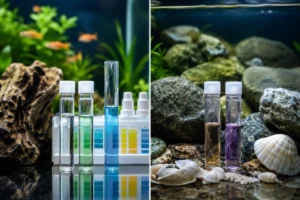
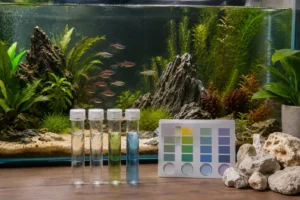
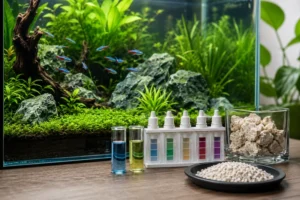
To understand pH stability, one test is not enough. You need trends. Test at consistent times, compare aquarium water with source water, and always include KH.
In CO₂-injected tanks, test before CO₂ starts and during the CO₂ period. In non-CO₂ tanks, test at the same time of day when comparing results. If pH swings after water changes, test the replacement water before it enters the aquarium.
pH stability testing checklist
- Test aquarium pH at the same time of day.
- Test KH together with pH.
- Test GH to understand mineral context.
- Test tap water immediately and after resting.
- Test before and after water changes if swings occur.
- Test ammonia and nitrite if livestock are stressed.
- In CO₂ tanks, test pH before CO₂ and during injection.
- Record results over time instead of reacting to one reading.
Stable aquariums are managed through patterns, not panic reactions.
How to Keep Aquarium pH Stable
Keeping aquarium pH stable means building predictable water chemistry. You do that by matching source water, buffering, substrate, hardscape, livestock, CO₂, and water-change routine.
Step 1: Know your source water
Test tap water pH, KH, and GH. Let a sample rest and test again. Your aquarium stability starts with your source water. If your tap water is hard and alkaline, the tank will tend to move in that direction after water changes. If your tap water is soft with low KH, pH may be easier to shift.
Step 2: Match livestock to your water
The easiest way to keep pH stable is to choose livestock that fit your natural water. Constantly modifying hard tap water for soft-water species, or soft water for hard-water species, increases complexity and risk.
Step 3: Keep KH appropriate
KH should match the setup. Low-KH aquariums need consistency and careful livestock choice. Higher-KH aquariums have stronger buffering but may be harder to adjust downward. Do not change KH suddenly in stocked tanks.
Step 4: Avoid repeated pH chemicals
Repeated pH-up and pH-down products often create swings. They may change the number temporarily without solving the cause. Fix source water, KH, substrate, hardscape, CO₂, or maintenance instead.
Step 5: Keep water changes consistent
Consistent water changes help maintain predictable chemistry. Irregular large changes can create bigger swings than smaller routine changes. Match temperature and prepare water consistently.
Step 6: Control organic waste
Remove uneaten food, dead plant matter, and excess debris. Clean mechanical filter media when needed without destroying biological media. Prevent long-term buildup that can shift water chemistry.
What Not to Do When pH Is Unstable
pH instability often becomes worse when aquarists react too quickly. The goal is stable correction, not fast cosmetic numbers.
- Do not chase pH with repeated chemicals. Fix the cause instead.
- Do not ignore KH. pH stability depends strongly on buffering.
- Do not make sudden large changes in shrimp tanks. Shrimp are sensitive to swings.
- Do not use pure RO water without remineralization. It lacks stable buffering.
- Do not keep carbonate rocks in a soft-water setup. They may raise pH and hardness.
- Do not fight active soil with constant pH-up products. Build around the soil’s chemistry.
- Do not assume pH is the only problem. Test ammonia, nitrite, oxygen, KH, and temperature.
- Do not compare pH readings taken at different times without context. CO₂ and plant activity matter.
Stable Aquarium pH Troubleshooting Table
Use this table to connect pH patterns with likely causes and first actions.
| Problem | Likely Cause | First Action |
|---|---|---|
| pH keeps dropping | Low KH, organic buildup, active soil | Test KH and review maintenance/substrate |
| pH keeps rising | Carbonate rocks, hard tap water, substrate | Test KH/GH and inspect materials |
| pH swings after water changes | Source water mismatch | Test tap water and match replacement water |
| pH drops during CO₂ period | Dissolved CO₂ | Check CO₂ timing, KH, and fish behavior |
| pH crashes suddenly | Very low KH or exhausted buffering | Test KH and stabilize gradually |
| pH-down does not hold | High KH buffering | Address source water and KH |
| Shrimp die after water change | pH/KH/GH/temperature swing | Test old and new water parameters |
| Fish gasp during CO₂ | CO₂ excess or low oxygen | Increase aeration and adjust CO₂ safely |
Stable pH Checklist
Use this checklist when you want to build a more stable aquarium pH routine.
- Test aquarium pH, KH, and GH.
- Test tap water pH, KH, and GH.
- Check whether pH changes after water changes.
- Check whether pH changes during CO₂ injection.
- Review substrate and hardscape for pH influence.
- Remove unwanted carbonate sources in soft-water tanks.
- Remineralize RO water consistently.
- Keep water changes regular and predictable.
- Reduce organic waste buildup.
- Choose livestock that match your stable water.
- Avoid repeated chemical pH chasing.
- Record trends over time.
Quick Takeaways
- Stable pH matters more than perfect pH.
- KH is the main buffer that helps prevent pH swings.
- Low KH can make pH easier to move and increase crash risk.
- High KH can make pH difficult to lower and cause rebound.
- CO₂ injection can create controlled daily pH movement.
- Water changes can cause swings if source water differs from tank water.
- Active soil can lower pH and KH, especially when new.
- Carbonate rocks and substrates can raise pH and hardness.
- Repeated pH chemicals often create instability.
- The best long-term strategy is matching livestock, source water, buffering, and routine.
Conclusion
Stable aquarium pH is one of the foundations of healthy freshwater aquarium keeping. The goal is not to force every tank to neutral pH. The goal is to create predictable water chemistry that matches your livestock, plants, substrate, hardscape, and maintenance routine.
If pH is stable and suitable, avoid unnecessary correction. If pH swings, test KH first. If CO₂ is involved, understand the daily pattern. If water changes cause instability, test source water. If rocks, substrate, or soil are changing the water, decide whether they match your aquarium goals.
From here, continue with the Aquarium pH Guide, read Aquarium pH Too Low or Aquarium pH Too High, and use the Aquarium pH / CO₂ Calculator if you run a planted tank with CO₂.
Next step:
If your aquarium pH is unstable, test KH before changing anything. Then compare tank water with source water, review CO₂ timing, and check whether substrate, rocks, soil, or water changes are causing the swing.
💬 Join the Conversation
Tag us on Instagram @AquariumLesson — we’d love to see your water test results, planted tanks, and pH-stability routines.
👉 Is your aquarium pH stable, or does it move after water changes, CO₂ injection, or new hardscape?
FAQ
How do I keep aquarium pH stable?
Keep aquarium pH stable by testing KH, using consistent source water, avoiding repeated pH chemicals, matching livestock to your water, keeping water changes predictable, controlling organic waste, and understanding whether CO₂, soil, rocks, or substrate affect the tank.
Why does my aquarium pH keep changing?
Aquarium pH may change because of low KH, source-water differences, CO₂ injection, active soil, carbonate rocks, substrate, organic waste buildup, RO water without remineralization, or repeated pH-adjusting products.
Is stable pH more important than perfect pH?
Yes. For many freshwater aquariums, stable pH is more important than hitting one perfect number. Fish and shrimp are often stressed more by sudden swings than by a stable pH that suits their species.
What does KH do for pH?
KH buffers aquarium water and helps resist pH changes. Low KH allows pH to move more easily, while high KH makes pH more resistant to change and harder to lower.
Can CO₂ cause pH swings?
Yes. CO₂ injection lowers pH while CO₂ is dissolved in the water. In planted tanks, this daily movement can be normal if controlled, but excessive CO₂ or poor oxygenation can stress fish and shrimp.
Why does pH change after a water change?
pH changes after water changes when replacement water has different pH, KH, GH, temperature, or dissolved gas levels than the aquarium. Test both tank water and source water to understand the difference.
Can low KH cause a pH crash?
Yes. Very low KH means weak buffering, which can make pH more vulnerable to sudden drops. Low KH is not always bad, but it requires consistent management and suitable livestock.
Should I use pH-up or pH-down products?
Use pH-adjusting products carefully. Repeated pH-up or pH-down corrections often create instability if KH, source water, substrate, rocks, or CO₂ are not addressed. Fix the cause instead of chasing the number.
Can rocks make pH unstable?
Some rocks can raise pH, KH, or GH over time. Limestone, coral, shells, aragonite, crushed coral, and carbonate-rich stones can push water toward alkaline conditions, especially in soft-water setups.
Can RO water make pH unstable?
Yes. Pure RO water has very low buffering and mineral content. It should usually be remineralized to suitable KH and GH before aquarium use, especially for shrimp, snails, plants, and stable pH management.
Lesson completed!
You've finished this lesson. Keep building your aquarium knowledge, one lesson at a time.
Continue learning →New to AquariumLesson? Start with our complete Aquarium Lessons Hub or return to the homepage at AquariumLesson.com.
References
- University of Missouri Extension. Water Quality for Fish Culture.
- Mississippi State University Extension. pH and Alkalinity.
- North Central Regional Aquaculture Center. An Introduction to Water Chemistry in Freshwater Aquaculture.
- FAO. Environment and Fish Health: Water Quality for Aquaculture.
- AquariumLesson. Aquarium pH Guide.