
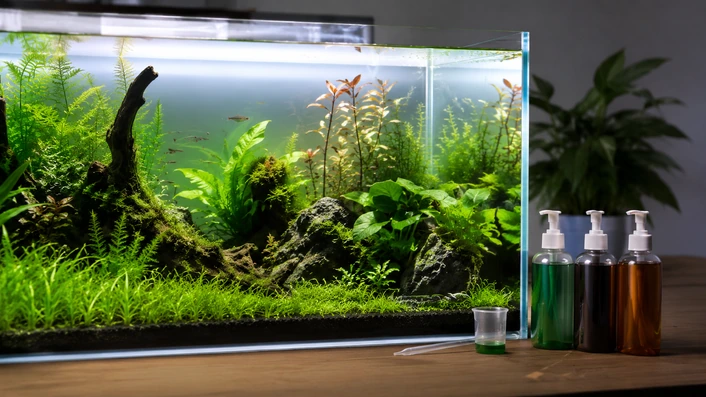
Aquarium Fertilizer Guide: Complete Plant Nutrient Basics
Introduction
This aquarium fertilizer guide explains how planted tank fertilization actually works: what plants need, when liquid fertilizer is enough, when root tabs matter, how macros and micros differ, and how to choose a dosing routine that fits your aquarium instead of copying random numbers from another setup.
Aquarium fertilizer can feel confusing because planted tanks do not all need the same thing. A low-light aquarium with Anubias and Java Fern does not need the same dosing method as a high-tech aquascape with CO₂, carpet plants and fast stems. A shrimp tank needs stability. A Dutch-style layout needs frequent nutrition. A soil-based aquascape may rely heavily on the root zone, while an epiphyte-heavy tank depends more on water-column nutrients.
The goal is not to dose as much fertilizer as possible. The goal is to keep plants healthy without creating instability. Plants need macronutrients, micronutrients, trace elements, minerals, light, carbon, flow and maintenance working together. Fertilizer is only one part of the system, but it becomes essential once plant demand rises above what fish waste, substrate and source water can provide.
This guide is the foundation article for the AquariumLesson fertilizer cluster. For deeper nutrient theory, read Macronutrients for Aquarium Plants, Micronutrients for Aquarium Plants and Trace Elements for Aquarium Plants. For advanced dosing methods, compare EI Dosing with Lean Dosing.
Quick answer: Aquarium plants need fertilizer when fish waste, substrate and tap water do not provide enough nutrients for healthy growth. Most beginner planted tanks do best with a complete liquid fertilizer plus root tabs for heavy root feeders. High-tech tanks may need structured macro and micro dosing.
What You’ll Learn in This Lesson
- What aquarium fertilizer actually does
- Which nutrients aquarium plants need
- How liquid fertilizers, root tabs, aquasoil and dry salts differ
- When to use all-in-one fertilizer, macro fertilizer or micro fertilizer
- How low-tech and high-tech tanks need different dosing routines
- How to recognize common fertilizer deficiency symptoms
- How to avoid algae caused by imbalance, not fertilizer itself
- How to build a simple fertilizer schedule for your planted tank
Do Aquarium Plants Need Fertilizer?
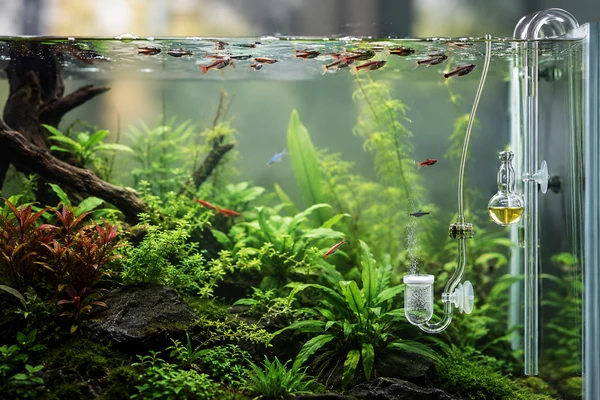
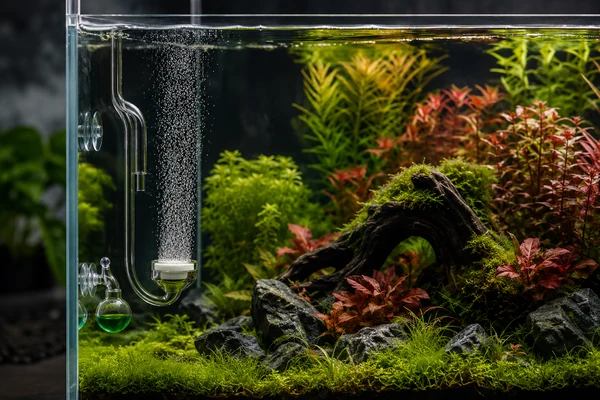
Yes, aquarium plants need nutrients. Whether they need additional fertilizer depends on how much nutrition the aquarium already provides through fish food, fish waste, substrate, tap water and soil.
In a lightly planted fish tank, plants may survive for a long time with nutrients produced by the aquarium itself. But survival is not the same as strong growth. Once you add more plants, brighter light, CO₂, carpeting plants, fast stems, floating plants or demanding aquascape species, natural nutrient input often becomes too weak or too inconsistent.
Aquarium fertilizer becomes necessary when plants show deficiency symptoms, stop growing, lose color, melt repeatedly, develop holes, fail to recover after trimming or cannot compete with algae because their growth is limited.
Plants may need fertilizer if:
- New leaves are pale or weak
- Older leaves turn yellow too early
- Leaves develop pinholes or brown patches
- Stem plants stop producing strong tops
- Carpets stop spreading
- Floating plants become pale or small
- Red plants lose growth quality
- Plants recover poorly after trimming
- Algae appears while plants look stalled
A planted tank does not need random fertilizer. It needs the right nutrients in the right place, at the right intensity, for the actual plant demand.
Ready to set up your own tank?
Create a free account to save lessons, plan your setup, and use the Tank Hub to turn ideas into a real aquarium.
What Nutrients Do Aquarium Plants Need?
Aquarium plants need several nutrient groups. The most important distinction is between macronutrients and micronutrients. Macronutrients are needed in larger amounts. Micronutrients and trace elements are needed in smaller amounts but remain essential for healthy new growth.
Plants also need carbon, light and minerals. Fertilizer cannot replace poor lighting or unstable CO₂. It only supplies nutrients. Healthy planted tanks happen when all parts of the system support each other.
| Nutrient Group | Examples | Why Plants Need It |
|---|---|---|
| Macronutrients | Nitrogen, phosphorus, potassium | Leaf growth, roots, energy transfer, tissue strength and plant mass |
| Secondary nutrients | Calcium, magnesium, sulfur | Mineral balance, chlorophyll, cell structure and metabolism |
| Micronutrients | Iron, manganese, zinc, boron, copper, molybdenum | New growth, enzymes, pigments, chlorophyll support and trace functions |
| Carbon | CO₂ from gas exchange or injection | Major growth building block, especially in high-light tanks |
| Light energy | PAR from aquarium lighting | Drives photosynthesis and determines nutrient demand |
For a full breakdown of the main nutrient groups, start with the Macronutrients for Aquarium Plants and Micronutrients for Aquarium Plants guides.

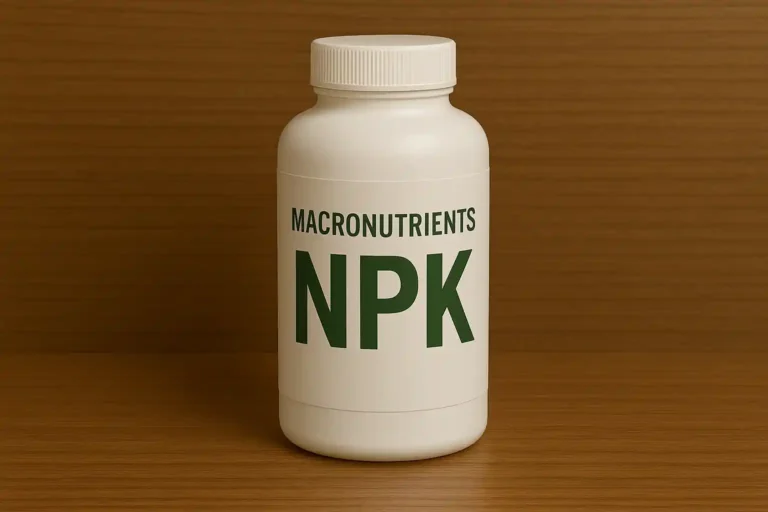
Macronutrients: Nitrate, Phosphate and Potassium
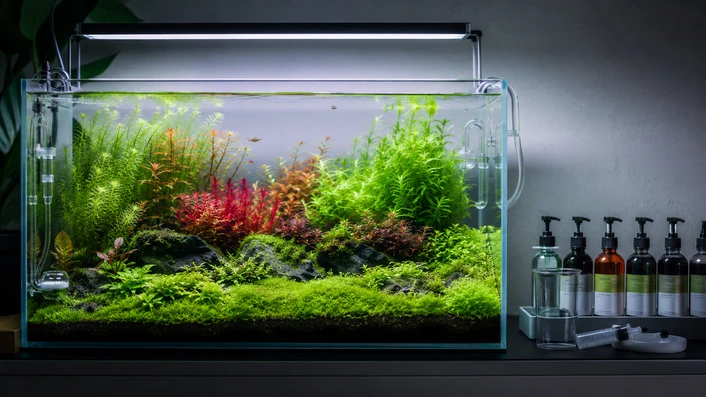
Macronutrients are the nutrients plants use in larger amounts. In aquarium fertilizer, the most important macronutrients are nitrogen, phosphorus and potassium. These are often discussed as nitrate, phosphate and potassium.
Many beginners are told that nitrate and phosphate are only waste products. In planted aquariums, they are also plant nutrients. Too much waste can be a problem, but too little available nitrogen or phosphate can also limit plant growth.
| Macronutrient | Common Aquarium Form | Deficiency Pattern |
|---|---|---|
| Nitrogen | Nitrate or other nitrogen forms | Older leaves turn yellow, pale or translucent; growth slows |
| Phosphorus | Phosphate | Slow growth, small shoots, poor recovery and possible green spot algae |
| Potassium | Potassium salts in fertilizer | Pinholes, dark spots, necrosis and weak older leaves |
A good fertilizer routine keeps these nutrients available enough for plants to grow without letting the aquarium become dirty or unstable. If you suspect a specific deficiency, use the dedicated guides: Nitrogen Deficiency in Aquarium Plants, Phosphate Deficiency in Aquarium Plants and Potassium Deficiency in Aquarium Plants.
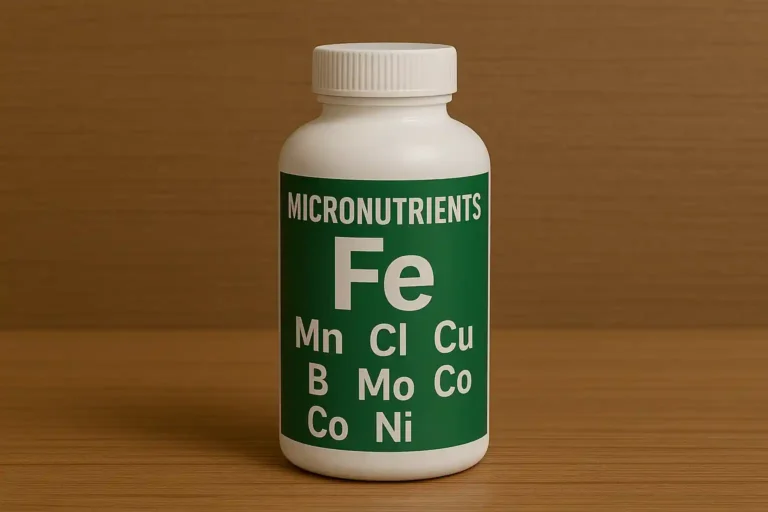
Micronutrients and Trace Elements
Micronutrients are needed in much smaller quantities than macronutrients, but they are still essential. Iron is the most familiar micronutrient, but aquarium plants also need manganese, zinc, boron, copper, molybdenum and other trace elements in tiny amounts.
Micronutrient deficiencies often appear in new growth because many trace elements are not easily moved from old leaves into new leaves. Pale new leaves, yellow shoot tips, weak new growth and deformed leaves can point toward micronutrient problems.
| Micronutrient | Main Role | Common Warning Sign |
|---|---|---|
| Iron | Chlorophyll support and new growth | Pale or yellow new leaves |
| Magnesium | Chlorophyll and photosynthesis | Older leaves pale between green veins |
| Manganese | Photosynthesis and enzyme systems | General weak or pale new growth |
| Boron | New tissue development | Distorted or weak new growth |
| Zinc | Growth regulation and metabolism | Small or weak growth |
| Copper and molybdenum | Trace enzyme functions | Usually managed through complete micro fertilizer |
Most aquarists should not dose every trace element separately. A complete micronutrient fertilizer is usually safer and easier. For deeper diagnosis, read Iron Deficiency in Aquarium Plants, Magnesium Deficiency in Aquarium Plants and Trace Elements for Aquarium Plants.
Liquid Fertilizer vs Root Tabs
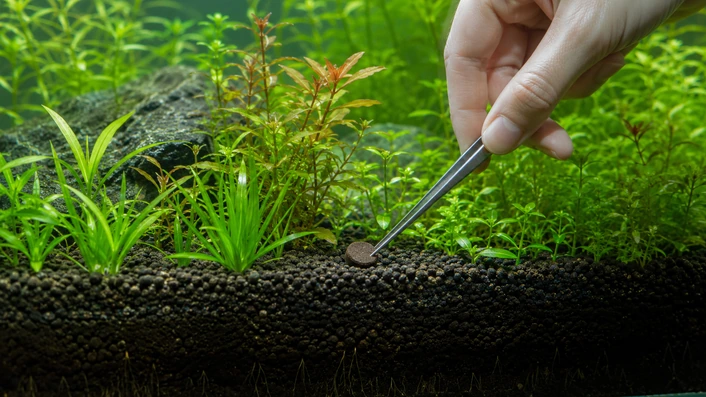
Liquid fertilizer and root tabs do different jobs. Liquid fertilizer adds nutrients to the water column. Root tabs add nutrients into the substrate. Many planted aquariums benefit from both, depending on plant selection.
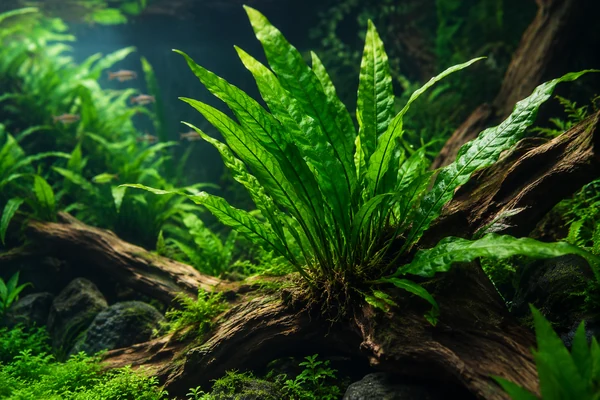
Epiphyte plants such as Anubias, Java Fern and Bucephalandra are attached to rocks or driftwood and rely heavily on water-column nutrients. Root tabs will not help them much because they are not rooted deeply in the substrate. Heavy root feeders such as Cryptocoryne, Echinodorus and many rosette plants benefit strongly from root-zone nutrition.
| Fertilizer Type | Best For | Limitations |
|---|---|---|
| Liquid fertilizer | Epiphytes, stem plants, floating plants, mosses and water-column feeders | May not fully support heavy root feeders in inert substrate |
| Root tabs | Cryptocoryne, swords, lotus, heavy rooted plants and inert substrates | Do not feed epiphytes or floating plants effectively |
| Aquasoil | Rooted plants, carpets, aquascapes and long-term root nutrition | Nutrients decline over time and water-column dosing may still be needed |
| Dry salts | Advanced custom dosing and large tanks | Requires accurate measurement and nutrient knowledge |
| All-in-one fertilizer | Beginner and medium-demand planted tanks | May not fit every high-tech or lean dosing strategy |
The best routine depends on where your plants feed. A tank full of stem plants and epiphytes needs reliable water-column dosing. A tank full of rooted rosettes in sand may need root tabs. A serious aquascape may use aquasoil, liquid macros, micros and CO₂ together.
All-In-One Aquarium Fertilizer
All-in-one aquarium fertilizer is the easiest option for many planted tanks. It usually combines several nutrients in one bottle so beginners do not need separate macro and micro products. A good all-in-one fertilizer may include nitrate, phosphate, potassium, iron and trace elements, depending on the formula.
However, not every all-in-one fertilizer is truly complete for every aquarium. Some products are designed for low-tech tanks and contain little or no nitrate and phosphate. Others are designed for high-demand planted tanks. Always read the label instead of assuming one bottle fits every situation.
An all-in-one fertilizer is best when:
- You want a simple routine
- Your tank is low-tech or medium-tech
- You have mixed plant types
- You do not want to dose dry salts
- You want a beginner-friendly starting point
- Your plant demand is moderate
- You can adjust based on symptoms and growth
The main risk is assuming “complete” means perfect. A lightly stocked, heavily planted tank may need more nitrogen than the bottle provides. A fish-heavy tank may not need extra nitrate but may still need potassium and micros. Match the fertilizer to the aquarium.
Macro and Micro Fertilizers
Some planted tank routines separate macro and micro fertilizers. This gives more control than an all-in-one product. Macros usually include nitrate, phosphate and potassium. Micros usually include iron and trace elements.
Separate dosing is useful when plant demand is high, when you want to adjust one nutrient group without changing another, or when you use advanced methods like EI or lean dosing. It is also helpful when fish load already supplies some nutrients but not others.
| Fertilizer Setup | Best For | Example Use |
|---|---|---|
| All-in-one fertilizer | Beginner and moderate planted tanks | Simple weekly or several-times-weekly dosing |
| Macro + micro bottles | Medium to high-demand tanks | Macros on some days, micros on others |
| Separate nitrate, phosphate and potassium | Advanced aquascapes | Fine-tuning nutrient balance |
| Iron supplement only | Clear iron limitation | Supporting pale new growth when macros are stable |
| Dry salts | Large tanks and advanced custom dosing | Cost-effective precise dosing |
If you are not sure which approach you need, start simple. A complete fertilizer routine is easier to maintain than a complex method you cannot repeat consistently.
Fertilizer and Aquarium Soil
Aquarium soil changes fertilizer strategy because it provides nutrients through the root zone. Fresh aquasoil can support rooted plants, carpets and heavy root feeders strongly. This allows some aquascapes to use lower water-column nutrients, especially in lean dosing methods.
But aquasoil does not eliminate the need for fertilizer forever. Soil nutrients decline over time. Epiphytes and floating plants still rely heavily on water-column nutrients. Stem plants may need liquid fertilizer even when soil is active.
Aquasoil is useful because it can:
- Support root feeders
- Help carpeting plants establish
- Provide nutrients near the root zone
- Buffer early plant growth
- Support leaner water-column dosing
- Improve stability in planted aquascapes
However, old or exhausted aquasoil may need support from root tabs and liquid fertilizer. For substrate planning, read the Aquarium Soil Guide.
Fertilizer for Low-Tech Aquariums
Low-tech aquariums usually have low to moderate light and no pressurized CO₂. Plant growth is slower, so fertilizer demand is lower than in high-tech aquascapes. But low-tech does not mean no fertilizer.
Many low-tech tanks do well with a complete liquid fertilizer dosed once or several times per week, depending on plant mass. Root tabs are useful for heavy root feeders in sand or gravel. The goal is steady nutrition, not aggressive growth.
| Low-Tech Tank Type | Fertilizer Strategy | What to Watch |
|---|---|---|
| Epiphyte tank | Complete liquid fertilizer | Pale new leaves, algae on slow leaves, potassium issues |
| Crypt and sword tank | Liquid fertilizer plus root tabs | Yellowing older leaves, slow recovery, root feeder performance |
| Floating plant tank | Regular water-column nutrients | Pale floaters, small leaves, nitrate limitation |
| Shrimp planted tank | Gentle complete dosing | Shrimp behavior and plant color |
| Low-tech aquascape | Moderate complete fertilizer and stable light | Slow deficiency signs and algae balance |
For low-tech setup strategy, read No CO₂ Planted Tank. Fertilizer should match the slower energy level instead of forcing high-tech growth.
Fertilizer for High-Tech Aquariums
High-tech aquariums use stronger light and CO₂ injection. This increases plant demand dramatically. When plants grow faster, they consume nutrients faster. A simple low-dose fertilizer may not keep up.
High-tech tanks often need structured macro and micro dosing. Some aquarists use EI dosing to keep nutrients non-limiting. Others use lean dosing with aquasoil and controlled nitrate. Both can work, but both require consistency and plant observation.
High-tech fertilizer routines should account for:
- Strong plant demand from high PAR lighting
- CO₂ stability and distribution
- Fast nutrient uptake from stem plants and carpets
- Regular trimming and regrowth
- Macro and micro balance
- Substrate nutrition and root tabs if needed
- Water changes and nutrient reset strategy
- Algae risk when light exceeds plant balance
If your tank uses strong light and CO₂, fertilizer must be treated as part of the whole system. Read Aquarium CO₂ System Guide, Aquarium PAR Explained and Aquarium Lighting and Algae before increasing fertilizer or light blindly.
EI Dosing, Lean Dosing and Simple Dosing Compared
There are several ways to fertilize a planted aquarium. The best method depends on plant demand, light intensity, CO₂, substrate, livestock and maintenance style.
| Dosing Method | Main Idea | Best For |
|---|---|---|
| Simple all-in-one dosing | Use one complete fertilizer on a regular schedule | Beginner, low-tech and medium-demand tanks |
| Root tab support | Add nutrients directly into the substrate | Crypts, swords, lotus and root-heavy plants |
| EI dosing | Generous nutrients plus large water changes | High-tech tanks with strong CO₂ and fast growth |
| Lean dosing | Controlled lower water-column nutrients | Aquasoil aquascapes, red plant strategies and controlled growth |
| Dry-salt dosing | Custom nutrients mixed from salts | Advanced aquarists and large aquariums |
| Test-based dosing | Adjust fertilizer based on measured nutrient trends | Advanced users who enjoy monitoring |
For many aquarists, the best starting point is simple all-in-one fertilizer plus root tabs where needed. Once plant demand becomes more advanced, compare EI Dosing and Lean Dosing.
How Often Should You Dose Aquarium Fertilizer?
Fertilizer frequency depends on the tank. Low-tech tanks may only need dosing once or several times per week. High-tech tanks often benefit from smaller, more frequent doses. Some aquarists dose daily to keep nutrient availability stable.
The important point is consistency. Plants prefer predictable availability over random large corrections. If you forget fertilizer for weeks and then add a large dose, the tank becomes harder to interpret.
| Aquarium Type | Typical Dosing Rhythm | Practical Note |
|---|---|---|
| Low-light beginner tank | Once or twice per week | Start modestly and observe growth |
| Low-tech planted tank | Two to three times per week | Adjust based on plant mass and symptoms |
| Medium-tech tank | Several times per week | More plants and stronger light need more consistency |
| High-tech CO₂ tank | Several times per week or daily | Macro and micro routines may be separated |
| Shrimp planted tank | Small conservative doses | Prioritize stability and livestock response |
| Root feeder tank | Liquid dosing plus root tabs every few weeks or months | Root tab frequency depends on product and plant demand |
Always follow the product label as a starting point, then adapt carefully. If you want precise additions, use the Fertilizer Dosing Calculator.
How Much Fertilizer Should You Add?
The correct fertilizer amount depends on tank volume, plant mass, light intensity, CO₂, fish load, substrate and water-change routine. There is no universal dose that works for every aquarium.
Start with the label recommendation or a conservative fraction of it in sensitive setups. Then judge plant response over time. Do not change light, CO₂ and fertilizer all at once, because you will not know which factor caused improvement or problems.
Increase fertilizer gradually if:
- Plants show clear deficiency symptoms
- Fast growers stall despite good light and CO₂
- Floating plants become pale or small
- Carpets stop spreading while light and CO₂ are adequate
- Water-column nutrients repeatedly test very low
- Plant mass has increased significantly
Reduce or adjust fertilizer if:
- Plant demand is low and nutrients accumulate
- You are dosing high-energy amounts into a low-light tank
- Fish load already supplies high nitrate or phosphate
- Algae appears after light or fertilizer changes
- Livestock show stress after dosing or water changes
The best dose is the dose that supports healthy growth without forcing the aquarium beyond its energy level.
Fertilizer and Algae: Does Fertilizer Cause Algae?
Fertilizer does not automatically cause algae. Algae usually appears when the overall system is unbalanced. Too much light, unstable CO₂, weak plant growth, organic waste, poor flow, excess feeding and inconsistent maintenance are often more important than fertilizer alone.
Starving plants to fight algae often backfires. When plants lack nutrients, they grow weaker and compete less effectively. Algae can then take advantage of light and instability.
Fertilizer can contribute to algae problems if it is mismatched to the system. For example, strong fertilizer in a very low-light tank with few plants may accumulate. High light with unstable CO₂ may create algae even when fertilizer is correct. Zero nitrate or phosphate may weaken plants and still lead to algae.
Algae prevention is about balance:
- Match light to plant demand
- Keep CO₂ stable in high-tech tanks
- Provide enough nutrients for plants
- Avoid excessive organic waste
- Maintain flow and remove debris
- Do regular water changes
- Trim unhealthy growth
- Do not chase zero nutrients blindly
If algae appears after changing your fertilizer, review the full system with Aquarium Lighting and Algae.
Common Aquarium Fertilizer Deficiency Symptoms
Deficiency symptoms help you understand what plants might be missing. They are not perfect, because many symptoms overlap. Still, leaf age, color, holes and growth speed can guide your next step.
| Symptom | Possible Cause | Next Guide |
|---|---|---|
| Older leaves turn yellow | Nitrogen deficiency | Nitrogen Deficiency in Aquarium Plants |
| Slow growth and small shoot tips | Phosphate limitation or CO₂/light issue | Phosphate Deficiency in Aquarium Plants |
| Pinholes and necrotic leaf damage | Potassium deficiency or livestock damage | Potassium Deficiency in Aquarium Plants |
| Pale new leaves | Iron or trace element issue | Iron Deficiency in Aquarium Plants |
| Older leaves pale between green veins | Magnesium or GH issue | Magnesium Deficiency in Aquarium Plants |
| Weak new tips and distorted growth | Trace elements, calcium, CO₂ or severe imbalance | Trace Elements for Aquarium Plants |
| Algae with weak plant growth | System imbalance | Aquarium Lighting and Algae |
Do not diagnose from one leaf. Look for repeated patterns across several plants and judge recovery by new growth after correction.
Fertilizer for Different Plant Types
Different aquarium plants feed differently. This is why one fertilizer routine may work for one layout but fail in another.
| Plant Type | Main Nutrient Path | Fertilizer Strategy |
|---|---|---|
| Epiphytes | Water column | Liquid fertilizer with potassium and micros |
| Stem plants | Water column and roots | Regular macro and micro dosing |
| Carpeting plants | Roots and water column | Aquasoil, liquid nutrients and stable CO₂/light |
| Cryptocoryne | Root zone | Root tabs or aquasoil plus moderate water-column nutrients |
| Swords and lotus plants | Strong root feeding | Root tabs or rich substrate |
| Floating plants | Water column | Regular nitrate, potassium and trace availability |
| Mosses | Water column | Gentle liquid nutrients and clean flow |
A heavily rooted plant in inert sand may struggle without root tabs. An epiphyte attached to wood may struggle without liquid fertilizer. Match fertilizer to plant biology.
Fertilizer and Water Changes
Water changes affect fertilizer because they remove nutrients, organic waste and dissolved compounds. After a water change, the aquarium often needs nutrients replaced through fertilizer, especially in planted tanks with low-nutrient source water.
EI dosing uses large weekly water changes as a deliberate reset. Lean dosing may use smaller or more moderate water changes, but still depends on consistency. Low-tech tanks also benefit from regular changes because stable maintenance prevents slow buildup and keeps nutrients predictable.
Water changes matter because they:
- Remove excess nutrients and waste
- Replace minerals depending on source water
- Reset dosing mistakes
- Improve water clarity
- Reduce dissolved organics
- Support fish, shrimp and bacteria
- Make fertilizer routines easier to repeat
If you change large amounts of water but never redose nutrients, plants may become deficient. If you dose heavily but rarely change water, nutrients and organics may accumulate. Balance both sides. For water-change planning, read the Aquarium Water Change Guide.
Fertilizer and Tap Water
Tap water can contain minerals and sometimes nitrate or phosphate, but its nutrient profile varies by location. Some tap water contains useful calcium and magnesium. Some is very soft. Some contains nitrate. Some is almost nutrient-poor for plants.
This means your fertilizer routine should consider source water. Two aquarists using the same fertilizer can get different results because their water is different.
Important source water factors include:
- GH for calcium and magnesium
- KH and pH stability
- Nitrate already present in tap water
- Phosphate already present or absent
- Very soft water needing remineralization
- RO water requiring complete mineral rebuilding
- Hard water affecting nutrient availability
If you use RO water, fertilizer alone may not rebuild the mineral foundation. You may also need a remineralizer for GH and magnesium stability.
Fertilizer for Fish Tanks vs Planted Aquascapes
A fish tank with some plants and a planted aquascape are not the same fertilization challenge. A fish-heavy tank may naturally produce nitrate and phosphate from feeding. A plant-heavy aquascape may consume nutrients quickly and need regular dosing even with livestock present.
| Tank Type | Natural Nutrient Input | Fertilizer Need |
|---|---|---|
| Fish-heavy community tank | Often higher nitrate and phosphate from feeding | May still need potassium, iron and traces |
| Lightly stocked planted tank | Low fish waste | Often needs complete macro and micro support |
| Shrimp tank | Usually low waste | Gentle complete fertilizer may be needed |
| High-tech aquascape | Plant demand often exceeds natural input | Structured dosing recommended |
| Epiphyte hardscape tank | Depends on livestock | Water-column fertilizer is important |
| Soil-based planted tank | Substrate provides root nutrition | Still may need liquid fertilizer over time |
Do not add more fish just to fertilize plants. Stocking should be based on animal welfare and tank capacity. Fertilizer is easier to control than excess bioload.
Can You Overdose Aquarium Fertilizer?
Yes, you can overdose aquarium fertilizer, especially if you dose heavily into a tank with low plant demand, poor water changes or sensitive livestock. However, many plant problems come from underdosing or imbalance rather than simple “too much fertilizer.”
Overdosing is more likely when aquarists add multiple products without understanding overlap. For example, an all-in-one fertilizer, separate nitrate, separate potassium, root tabs and mineral boosters can stack nutrients quickly.
Signs your routine may be too heavy or mismatched include:
- Nutrients accumulating despite water changes
- Algae increasing after dosing changes
- Plants not growing enough to use the nutrients
- Livestock reacting after fertilizer additions
- Very high nitrate or phosphate from combined fish load and dosing
- Confusion caused by too many overlapping products
The safest approach is to know what each product adds. Avoid stacking fertilizers blindly. If needed, use the Fertilizer Dosing Calculator to estimate what your routine contributes.
A Simple Aquarium Fertilizer Schedule for Beginners
A beginner fertilizer schedule should be simple enough to repeat. It should not require daily testing or advanced chemistry. Start with plant demand, then choose a routine.
| Setup | Beginner Fertilizer Schedule | Extra Support |
|---|---|---|
| Low-light epiphyte tank | Complete liquid fertilizer once or twice weekly | Keep light moderate to avoid algae on slow leaves |
| Mixed beginner planted tank | Complete liquid fertilizer two times weekly | Root tabs for Crypts and swords |
| Sand or gravel with root feeders | Liquid fertilizer plus root tabs | Replace root tabs according to product instructions |
| Floating plant tank | Regular water-column fertilizer | Watch nitrate and potassium availability |
| Medium-tech planted tank | Complete fertilizer several times weekly | Adjust if plant mass increases |
| High-tech CO₂ aquascape | Structured macro and micro dosing | Consider EI or lean dosing depending on goals |
After two to four weeks, evaluate new growth. Do not judge only old damaged leaves. Healthy new leaves are the best sign that the fertilizer routine is working.
How to Choose the Right Aquarium Fertilizer
Choosing fertilizer becomes easier when you define the aquarium first. The best fertilizer is the one that matches your light, CO₂, substrate, livestock, plant mass and maintenance routine.
Use this decision guide:
| Your Situation | Best Starting Choice | Why |
|---|---|---|
| Beginner with mixed easy plants | Complete all-in-one liquid fertilizer | Simple and broad nutrient coverage |
| Sand tank with Crypts or swords | All-in-one liquid plus root tabs | Supports both water column and root zone |
| Tank with mostly Anubias, Java Fern and Buce | Complete liquid fertilizer | Epiphytes feed mainly from the water column |
| High-tech CO₂ tank | Separate macros and micros or structured dosing | Higher demand needs more control |
| Aquasoil red plant aquascape | Lean-style dosing with complete nutrients | Controlled water-column nutrients plus substrate support |
| Fast Dutch-style plant tank | EI or strong structured dosing | Fast stems consume nutrients quickly |
| Shrimp planted tank | Gentle complete fertilizer and stable minerals | Prioritizes livestock stability |
Do not choose fertilizer based only on brand popularity. Choose it based on what nutrients it contains and what your aquarium actually needs.
Common Aquarium Fertilizer Mistakes
Most fertilizer mistakes come from treating nutrients as isolated chemicals instead of part of a living system. Fertilizer must match light, CO₂, plant mass and maintenance.
| Mistake | Why It Causes Problems | Better Approach |
|---|---|---|
| Using no fertilizer in a planted tank | Plants eventually run out of key nutrients | Use complete nutrition matched to demand |
| Dosing iron for every yellow leaf | Yellowing can come from many causes | Check old vs new leaves first |
| Using only root tabs for epiphytes | Plants attached to hardscape need water-column nutrients | Use liquid fertilizer |
| Using only liquid fertilizer for heavy root feeders in sand | Root zone may remain weak | Add root tabs or nutrient-rich substrate |
| Increasing light without increasing CO₂ and nutrients | Plant demand rises and algae may appear | Balance light with CO₂ and fertilizer |
| Chasing zero nitrate or phosphate | Plants may become deficient | Keep nutrients available for planted tanks |
| Changing everything at once | You cannot identify the real cause | Adjust one main variable at a time |
A good fertilizer routine is consistent, understandable and matched to the aquarium’s real energy level.
Aquarium Fertilizer Troubleshooting Checklist
If your plants are struggling, use this checklist before buying another fertilizer bottle:
- Are symptoms appearing on old leaves or new leaves?
- Does your fertilizer contain nitrogen, phosphate and potassium?
- Does your fertilizer contain iron and trace elements?
- Are root feeders planted in nutrient-rich substrate or supported with root tabs?
- Are epiphytes receiving water-column nutrients?
- Is lighting too strong for your CO₂ and nutrient routine?
- Is CO₂ stable if you use high light?
- Is source water very soft or missing magnesium?
- Are water changes removing nutrients without replacement?
- Is fish load producing too much or too little nitrate?
- Are you judging recovery by new growth?
- Are you changing only one variable at a time?
If the answer points to a specific nutrient, use the dedicated deficiency guides before changing the whole system.
Final Recommendation
If you are new to planted aquariums, start with a complete all-in-one liquid fertilizer and add root tabs only for heavy root feeders in sand, gravel or older substrate. Keep the light moderate, avoid overcomplicating the routine and watch new growth over several weeks.
If you run a high-tech CO₂ aquascape, use a more structured routine. EI dosing is useful when you want non-limiting growth and regular large water changes. Lean dosing is useful when you want controlled growth, aquasoil support or a red plant strategy.
The best aquarium fertilizer is not the strongest one. It is the one that matches your tank’s plant demand, substrate, light, CO₂, livestock and maintenance rhythm.
Conclusion
Aquarium fertilizer is the nutrient support system behind healthy planted tank growth. Plants need macronutrients, micronutrients, trace elements, minerals, light and carbon. Fish waste, substrate and tap water may provide some of those nutrients, but they rarely provide everything reliably in a serious planted aquarium.
For beginner tanks, a complete liquid fertilizer plus root tabs for root feeders is usually the best starting point. For high-tech aquascapes, structured macro and micro dosing becomes more important. For aquasoil layouts and red plant systems, lean dosing may be useful. For dense fast-growth tanks, EI dosing can prevent nutrient limitation.
Do not fertilize randomly. Match fertilizer to your plants, observe old and new leaves, keep light and CO₂ balanced, and judge results by healthy new growth. When fertilizer is used correctly, it does not just make plants grow faster — it makes the entire planted aquarium more stable, predictable and resilient.
💬 Join the Conversation
What fertilizer routine are you using in your planted aquarium — all-in-one liquid fertilizer, root tabs, EI dosing, lean dosing, dry salts or aquasoil-based nutrition?
Tag us on Instagram @AquariumLesson — we’d love to see your plant growth, fertilizer routine and planted tank progress.
FAQ
What is the best aquarium fertilizer for beginners?
The best aquarium fertilizer for beginners is usually a complete all-in-one liquid fertilizer that includes macros and micros. If the tank has heavy root feeders in sand or gravel, add root tabs as well.
Do aquarium plants need liquid fertilizer?
Many aquarium plants benefit from liquid fertilizer, especially epiphytes, stem plants, mosses and floating plants. These plants take nutrients directly from the water column and may not benefit much from root tabs alone.
Are root tabs better than liquid fertilizer?
Root tabs are better for heavy root feeders such as Cryptocoryne, swords and lotus plants. Liquid fertilizer is better for water-column feeders such as Anubias, Java Fern, Bucephalandra, mosses, floating plants and stem plants.
Does aquarium fertilizer cause algae?
Aquarium fertilizer does not automatically cause algae. Algae usually appears when light, CO₂, nutrients, plant mass, organic waste or maintenance are out of balance. Starving plants can also make algae worse.
How often should I fertilize aquarium plants?
Low-tech tanks may need fertilizer once or twice per week. Medium and high-tech tanks may need several doses per week or daily dosing. The right frequency depends on light, CO₂, plant mass and fertilizer strength.
Can fish waste replace aquarium fertilizer?
Fish waste can provide some nitrogen and phosphate, but it does not reliably provide all nutrients aquarium plants need. Many tanks still need potassium, iron, trace elements, magnesium or root-zone support.
Should I use EI dosing or lean dosing?
Use EI dosing if you want fast, non-limited growth in a high-tech tank with CO₂ and regular water changes. Use lean dosing if you want more controlled growth, aquasoil support or a lower-nutrient red plant strategy.
Can I fertilize a shrimp tank?
Yes, but use aquarium-safe fertilizer carefully and dose conservatively. Shrimp tanks benefit from stable, gentle nutrition rather than sudden large changes. Avoid uncontrolled copper sources and watch shrimp behavior.
Start building your aquarium with the Tank Hub
Save your favorite lessons, organize your setup, and track your aquarium step by step in your personal Tank Hub.
New to AquariumLesson? Start with our complete Aquarium Lessons Hub or return to the homepage at AquariumLesson.com.
Continue learning
References
- Aquasabi — Fertilizing a Planted Aquarium
- Aquasabi — Deficiency Symptoms in Aquatic Plants
- Aquarium Co-Op — How to Fertilize Your Planted Tank the Easy Way
- Aquarium Gardens — Nutrients Guide for Planted Tanks
- PlantedBox — Aquarium Plant Fertilizer Guide
- UKAPS — Dosing With Dry Salts
- Tropica — Make Your Aquarium a Success