Aquarium Root Tabs Guide: Substrate Fertilizer for Plants
Introduction
Aquarium root tabs are slow-release fertilizer tablets or capsules placed directly into the substrate, where they feed aquarium plants through the root zone. They are especially useful for heavy root feeders such as Cryptocoryne, Amazon swords, Vallisneria, lotus plants, and many rooted rosette plants.
Root tabs are one of the easiest ways to improve plant growth in tanks with sand, gravel, older aquarium soil, or nutrient-poor substrate. Instead of adding all nutrients into the water column, root tabs place nutrients near the roots where certain plants use them most effectively.
But root tabs are often misunderstood. They are not a replacement for all liquid fertilizer. They do not feed floating plants. They do not help Anubias or Java Fern much if those plants are attached to rocks or driftwood. They can also cause algae or water-quality issues if they are overused, buried too shallowly, disturbed, or allowed to dissolve into the water column.
This guide explains when to use root tabs, which plants benefit most, how to place them, how often to replace them, how they compare with liquid fertilizer and aquasoil, and how to avoid common mistakes. For the broader nutrient foundation, start with the Aquarium Fertilizer Guide. If you want the macro and micro nutrient theory behind root tabs, read Macronutrients for Aquarium Plants and Micronutrients for Aquarium Plants.
Quick answer: Aquarium root tabs are best for rooted plants in sand, gravel, depleted aquasoil, or nutrient-poor substrate. Push them deep into the substrate near plant roots, replace them according to the product schedule, and still use liquid fertilizer if your tank also contains stem plants, floating plants, mosses, or epiphytes.
What You’ll Learn in This Lesson
- What aquarium root tabs are and how they work
- Which aquarium plants benefit most from root tabs
- When root tabs are better than liquid fertilizer
- When liquid fertilizer is still necessary
- How to place root tabs in sand, gravel and aquasoil
- How often to replace root tabs
- How root tabs can cause algae if used incorrectly
- How to build a complete fertilizer routine around substrate feeding
What Are Aquarium Root Tabs?
Aquarium root tabs are concentrated fertilizer tablets, capsules, sticks, or pellets designed to be buried in the substrate. They slowly release nutrients near plant roots. This makes them different from liquid fertilizer, which adds nutrients directly to the water column.
Most root tabs contain a mix of macronutrients and micronutrients. Depending on the product, they may include nitrogen, phosphorus, potassium, iron, trace elements, and sometimes other minerals. The exact formula varies, so always read the label instead of assuming every root tab contains the same nutrients.
Root tabs are useful because many aquarium plants are strong root feeders. They can absorb nutrients through leaves and stems too, but they perform best when the substrate contains available nutrition. In plain sand or gravel, those plants may survive but grow slowly, stay small, lose color, or develop deficiency symptoms.
Root tabs are especially useful when:
- The aquarium uses inert sand or gravel
- The aquasoil is old or depleted
- Rooted plants grow slowly despite liquid fertilizer
- Cryptocoryne or sword plants show weak growth
- New rooted plants need help establishing
- The tank is low-tech but still planted heavily
- You want targeted feeding without raising water-column nutrients too much
Root tabs work best when they are placed close to the roots and buried deeply enough that nutrients stay in the substrate instead of leaking directly into the water.
How Root Tabs Work in the Substrate
Root tabs work by creating a local nutrient zone around plant roots. Once buried, they slowly dissolve or break down. Nutrients then move through the surrounding substrate and become available to rooted plants.
This is why placement matters. A root tab buried far away from the plant may not help much. A tab buried too shallowly may dissolve into the water column and contribute to algae. A tab disturbed during gravel vacuuming may release a concentrated nutrient cloud into the aquarium.
Think of root tabs as targeted root-zone fertilizer. They are not meant to float, sit on top of the substrate, or be scattered randomly where no rooted plants are growing.
| Root Tab Action | What Happens | Why It Matters |
|---|---|---|
| Buried near roots | Nutrients release into the root zone | Best use for Crypts, swords and rooted plants |
| Buried too shallow | Nutrients may leak into the water column | Can increase algae or clouding risk |
| Placed far from plants | Roots may not access nutrients efficiently | Wasted fertilizer |
| Disturbed during maintenance | Concentrated nutrients can enter the water | May trigger algae or water-quality issues |
| Replaced consistently | Root zone remains supplied | Supports long-term rooted plant growth |
The deeper and more stable the substrate, the easier root tabs are to use correctly. Very shallow sand beds or tanks with digging fish may require extra care.
Which Aquarium Plants Need Root Tabs?
Root tabs are most useful for plants that feed strongly from the substrate. These plants produce meaningful root systems and often respond well when nutrients are placed near their roots.
The strongest root-tab candidates are rosette plants, bulb plants, runners, and rooted background plants. They may still absorb nutrients from the water column, but root-zone nutrition gives them a major advantage.
| Plant Group | Root Tab Benefit | Examples |
|---|---|---|
| Cryptocoryne | Very high | Cryptocoryne wendtii, Cryptocoryne parva, Cryptocoryne balansae |
| Sword plants | Very high | Amazon sword, Echinodorus varieties |
| Lotus plants | High | Red tiger lotus, Nymphaea species |
| Vallisneria | High | Vallisneria spiralis, jungle val, Italian val |
| Dwarf Sagittaria | High | Sagittaria subulata |
| Rooted carpeting plants | Moderate to high | Monte Carlo, dwarf hairgrass, Marsilea in some setups |
| Stem plants | Moderate | Many stems benefit from both roots and water-column nutrients |
Root tabs are not equally important for every plant. A tank full of Crypts and swords may need them badly. A tank full of Anubias, Java Fern and mosses may barely benefit from them.
Plants That Usually Do Not Need Root Tabs
Some aquarium plants do not rely heavily on substrate nutrition. Epiphytes, mosses and floating plants mostly absorb nutrients from the water column. Root tabs buried in the substrate will not directly feed these plants unless nutrients escape into the water, which is not the goal.
Plants that usually need liquid fertilizer more than root tabs include:
- Anubias attached to wood or rocks
- Java Fern attached to hardscape
- Bucephalandra attached to rocks or wood
- Mosses such as Java moss or Christmas moss
- Floating plants such as Salvinia, frogbit or red root floaters
- Hornwort and other floating or loose-growing plants
- Stem plants that feed heavily from the water column
If your tank is dominated by these plants, start with a complete liquid fertilizer rather than root tabs. Root tabs may still help if you also keep rooted plants, but they should not be the main fertilizer for an epiphyte-heavy layout.
Root Tabs vs Liquid Fertilizer
Root tabs and liquid fertilizer are not enemies. They serve different nutrient pathways. Root tabs feed the substrate. Liquid fertilizer feeds the water column. Many planted aquariums need both because many aquariums contain both root feeders and water-column feeders.
The mistake is thinking one method automatically replaces the other. Root tabs are excellent for Crypts and swords in sand. Liquid fertilizer is essential for floating plants, epiphytes and many stem plants. A mixed planted tank often performs best with both.
| Fertilizer Type | Best For | Not Ideal For |
|---|---|---|
| Root tabs | Root feeders, sand, gravel, old soil, heavy rooted plants | Floating plants, epiphytes, mosses, water-column feeders |
| Liquid fertilizer | Stem plants, floaters, mosses, epiphytes, mixed tanks | Supporting heavy root feeders alone in inert substrate |
| Aquasoil | Rooted aquascapes, carpets, high-quality plant starts | Feeding epiphytes or floating plants by itself |
| Dry salts | Advanced water-column nutrient control | Beginner tanks without dosing experience |
| All-in-one fertilizer | Simple broad nutrition | Targeted root-zone feeding for large root feeders |
For most beginner planted tanks, the safest formula is simple: use liquid fertilizer for the water column, then add root tabs under heavy root feeders.
Root Tabs vs Aquarium Soil
Aquarium soil and root tabs both feed the root zone, but they work differently. Aquasoil is a nutrient-rich substrate used across the planted area. Root tabs are targeted nutrient additions placed where plants need them.
Fresh aquasoil can support rooted plants strongly from the beginning. Over time, however, aquasoil loses nutrients. Root tabs can refresh the root zone without replacing the entire substrate.
| Option | Strength | Best Use |
|---|---|---|
| Fresh aquasoil | Strong broad root-zone nutrition | New aquascapes, carpets, demanding rooted plants |
| Old aquasoil | Structure remains, nutrients decline | Use root tabs or liquid fertilizer to refresh plant support |
| Root tabs | Targeted nutrition where plants need it | Sand, gravel, older soil, large root feeders |
| Sand or gravel alone | Clean appearance but little nutrition | Needs root tabs for heavy root feeders |
| Soil plus root tabs | Can be powerful but may be excessive early | Use carefully once soil nutrient output declines |
If you are still planning the substrate, compare this guide with the Aquarium Soil Guide and Aquarium Sand Guide. Substrate choice determines how important root tabs become later.
When Should You Use Aquarium Root Tabs?
Use root tabs when rooted plants need more substrate nutrition than the tank currently provides. This is most common in sand, gravel, older aquasoil, or low-tech tanks where plants are growing slowly despite otherwise stable conditions.
Root tabs are also useful after replanting heavy root feeders. New roots need access to nutrients as they establish. A tab near the root zone can help the plant settle faster.
Good times to add root tabs include:
- When planting Cryptocoryne in sand or gravel
- When adding Amazon swords to inert substrate
- When Vallisneria is slow to spread
- When a tiger lotus produces weak leaves
- When old aquasoil no longer supports strong growth
- When rooted plants show yellowing or weak new leaves
- After moving or replanting heavy root feeders
- When root-feeding plants grow well at first, then stall months later
Do not add root tabs just because the tank has plants. Add them where rooted plants can actually use them.
How to Place Root Tabs Correctly
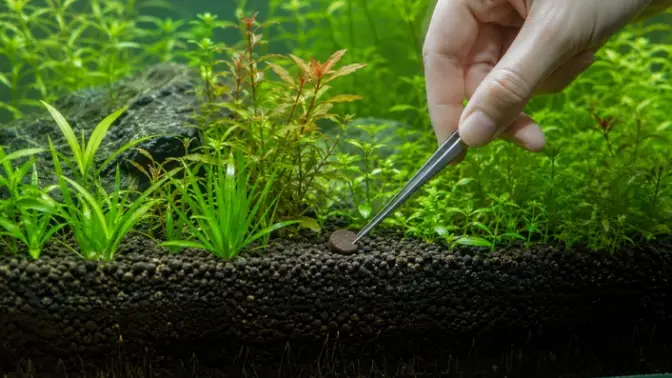
Correct placement is the most important part of using root tabs. A root tab should be pushed deep into the substrate near the plant’s roots. It should not sit on the surface, float around, or be placed where there are no rooted plants.
Use aquascaping tweezers, planting tongs, or clean fingers to push the tab down. The exact depth depends on substrate depth, but the tab should be well covered and protected from fish, shrimp, snails and maintenance tools.
Step-by-Step Placement
- Identify the plants that are heavy root feeders.
- Turn off strong flow if needed so the substrate is easier to work with.
- Push the root tab deep into the substrate near the plant base.
- Place it slightly to the side of the crown, not directly crushing the roots.
- Cover the tab completely with substrate.
- Avoid disturbing the tab during the next water change.
- Watch plant response over the following weeks.
For large plants such as Amazon swords, one tab may not be enough. A large root system may need several tabs placed around the plant, not directly stacked in one spot.
How Many Root Tabs Should You Use?
The number of root tabs depends on plant size, substrate area, product strength and plant demand. Always follow the product instructions first. Some tabs are strong and long-lasting. Others are smaller and need more frequent replacement.
As a practical guideline, root tabs should be placed near active root feeders rather than scattered everywhere. Dense rooted plant groups need more support than isolated small plants.
| Plant Situation | Typical Root Tab Strategy | Care Note |
|---|---|---|
| Single small Crypt | One tab nearby may be enough | Do not overdo it in a small tank |
| Large Amazon sword | Several tabs around the root zone may be needed | Large root feeders are nutrient-hungry |
| Vallisneria group | Tabs spaced along the runner area | Support spreading zones, not only one plant |
| Rooted carpet | Small tabs or spaced tabs beneath planted area | Avoid disturbing the carpet later |
| Mixed sand tank | Tabs only under root feeders, liquid fertilizer for others | Do not fertilize empty substrate |
| Old aquasoil tank | Tabs near demanding rooted plants | Refresh depleted root zones selectively |
More root tabs are not automatically better. Too many tabs in a small tank can create nutrient spikes if they are disturbed or dissolve into the water column.
How Often Should You Replace Root Tabs?
Root tab replacement depends on the product and plant demand. Many root tabs are designed to last several weeks to several months. The best starting point is always the manufacturer’s schedule.
Instead of replacing root tabs randomly, watch plant behavior. If rooted plants grow well after insertion but slow down again after a few months, the root zone may need renewal. If plants are still healthy and growing, you may not need to add more immediately.
Signs root tabs may need replacement include:
- Rooted plants slow down after earlier improvement
- Cryptocoryne leaves become smaller or paler
- Amazon swords produce weak new leaves
- Vallisneria stops spreading
- Lotus plants produce smaller leaves
- Root feeders show deficiency symptoms while water-column plants look fine
- Old aquasoil no longer supports strong rooted growth
In high-demand tanks, replacement may be more frequent. In slow low-tech tanks, replacement may be less frequent. The right rhythm is the one that keeps rooted plants stable without overloading the substrate.
Using Root Tabs in Sand
Root tabs are very useful in sand because plain aquarium sand contains little to no plant nutrition. Sand looks clean and natural, but heavy root feeders may struggle if there is no nutrient source below the surface.
The challenge is that sand can compact and may be shallow in some layouts. Root tabs should be buried deeply enough that they do not leach directly into the water. If the sand bed is too thin, root tabs may be difficult to use without disturbing the surface.
- Use root tabs under Crypts, swords, Vallisneria and lotus plants in sand.
- Bury tabs deeply and cover them completely.
- Avoid placing tabs in decorative open sand paths.
- Do not vacuum deeply around root tabs.
- Use planting tweezers to avoid stirring the substrate too much.
- Use liquid fertilizer for epiphytes, floating plants and stems.
Sand plus root tabs is a strong combination for natural-looking low-tech tanks, but the tabs must stay buried and targeted.
Using Root Tabs in Gravel
Root tabs can also work well in gravel, especially if the gravel is inert and nutrient-poor. The main issue is grain size. Coarse gravel allows more water movement around the tab, which may let nutrients escape faster into the water column.
Fine gravel is usually easier for rooted plants than very coarse gravel. If gravel is too large, plants may anchor poorly and root tabs may not stay covered as securely.
- Bury root tabs as deeply as possible in gravel.
- Place them near root feeders, not across empty areas.
- Avoid heavy gravel vacuuming around tabs.
- Watch for tabs surfacing after fish dig or plants are moved.
- Use root tabs more carefully in tanks with bottom-digging fish.
- Pair with liquid fertilizer for water-column feeders.
Gravel tanks often improve dramatically when root feeders receive substrate nutrition. But the tabs must be protected from being exposed.
Using Root Tabs in Aquarium Soil
Fresh aquarium soil often contains enough nutrients for rooted plants at the beginning. In a new soil-based aquascape, root tabs are usually not necessary immediately and may even be excessive if the soil is already nutrient-rich.
Root tabs become more useful as aquasoil ages and loses nutrient strength. After months or years, rooted plants may slow down even though the substrate still looks good. At that point, root tabs can refresh the root zone without rebuilding the aquarium.
| Aquasoil Stage | Root Tab Need | Best Approach |
|---|---|---|
| Brand-new nutrient-rich soil | Usually low | Let the soil support early growth first |
| Several months old | Moderate depending on plant demand | Add tabs near demanding root feeders if growth slows |
| Old depleted soil | Often useful | Use tabs to refresh root zones |
| Carpet-heavy aquascape | Depends on soil strength and water-column dosing | Use carefully to avoid disturbing the carpet |
| Epiphyte-focused tank | Low | Liquid fertilizer matters more than substrate tabs |
Root tabs are not a replacement for good aquasoil planning, but they are excellent for extending the life of an older substrate.
Root Tabs for Low-Tech Aquariums
Root tabs are especially useful in low-tech aquariums because many low-tech setups use sand, gravel, moderate lighting and easy rooted plants. Growth is slower than in CO₂-injected tanks, so root-zone nutrition can provide steady support without forcing fast water-column growth.
Low-tech tanks often contain Cryptocoryne, Vallisneria, dwarf Sagittaria, swords, lotus plants and other root feeders. These plants can perform well with root tabs even when the tank does not use CO₂.
- Use root tabs under heavy root feeders.
- Keep lighting moderate to avoid algae pressure.
- Use liquid fertilizer for epiphytes and floating plants.
- Do not overdose tabs in small tanks.
- Replace tabs gradually rather than all at once if the tank is sensitive.
- Watch rooted plant new growth over several weeks.
- Avoid disturbing tabs during maintenance.
For broader low-tech planning, read No CO₂ Planted Tank. Root tabs are useful, but they work best when the whole low-tech system is balanced.
Root Tabs for High-Tech Aquascapes
High-tech aquascapes with CO₂ and strong lighting usually rely on both water-column dosing and substrate nutrition. Root tabs can help heavy root feeders, old aquasoil zones and specific plant groups, but they rarely replace a complete macro and micro dosing routine.
In high-energy tanks, plant demand is higher. Root tabs may be useful under Crypts, swords, lotus plants, Vallisneria and rooted carpets, but water-column nutrients are still important for stems, epiphytes, mosses and fast-growing plant mass.
- Use root tabs as targeted root-zone support.
- Continue macro and micro water-column dosing if plant demand is high.
- Do not disturb tabs when trimming and replanting stems.
- Use tabs carefully under established carpets.
- Watch CO₂ and light balance before blaming root nutrition.
- Use tabs to refresh old aquasoil zones selectively.
For high-tech dosing strategy, compare EI Dosing and Lean Dosing. Root tabs can support either method, but they do not replace system balance.
Can Root Tabs Cause Algae?
Root tabs can contribute to algae if they are used incorrectly, but they do not automatically cause algae. The main risk comes from concentrated nutrients entering the water column too quickly.
This can happen when root tabs are buried too shallowly, dug up by fish, disturbed during maintenance, overused in a small tank, or placed in substrate that does not hold them well. If nutrients leak into the water while plants are not growing strongly enough to use them, algae may take advantage.
| Root Tab Mistake | Algae Risk | Better Approach |
|---|---|---|
| Tab left on substrate surface | High | Remove or bury deeply immediately |
| Tab buried too shallow | Moderate to high | Push deeper and cover completely |
| Too many tabs in small tank | Moderate | Use fewer tabs and target root feeders |
| Tabs disturbed during vacuuming | Moderate | Vacuum around tabs gently or avoid deep cleaning there |
| Tabs used without enough plant mass | Moderate | Add only where rooted plants can use nutrients |
| Tabs used correctly under root feeders | Low | Maintain stable light, CO₂ and water changes |
If algae appears after adding root tabs, do not assume the product itself is bad. Check placement, dosage, light intensity, water changes and whether the tank actually has enough rooted plant demand.
Can Root Tabs Harm Fish or Shrimp?
Aquarium-safe root tabs are generally designed for fish tanks when used correctly. The risk increases when tabs are exposed, overdosed, disturbed, or made from non-aquarium fertilizers that may release nutrients too aggressively or contain unsuitable additives.
Shrimp tanks require extra caution because shrimp are sensitive to unstable water chemistry. Root tabs can still be used, but they should be aquarium-safe, fully buried, and applied conservatively.
- Use only root tabs designed for aquarium use.
- Bury tabs completely and deeply.
- Avoid exposing tabs during maintenance.
- Use fewer tabs in small shrimp tanks.
- Watch livestock behavior after changes.
- Do not use garden fertilizer tablets in aquariums.
- Avoid DIY root tabs unless you understand the chemistry and risks.
When in doubt, choose a trusted aquarium product and start conservatively. Root-zone fertilization should support plants without destabilizing livestock conditions.
DIY Root Tabs: Are They Worth It?
DIY root tabs are popular among advanced hobbyists because they can be inexpensive and customizable. Some aquarists use dry salts, clay, capsules or slow-release fertilizer materials. However, DIY root tabs carry more risk than commercial aquarium root tabs.
The biggest problem is control. A DIY tab may release nutrients too quickly, contain unsuitable additives, float, break apart, or create localized ammonia or nutrient spikes. This is especially risky in small tanks, shrimp tanks and tanks with digging fish.
DIY root tabs may make sense if:
- You understand fertilizer chemistry
- You can measure nutrients accurately
- You know what each ingredient adds
- You are not keeping sensitive livestock
- You test and observe carefully
- You accept the risk of trial and error
For beginners, commercial aquarium root tabs are usually the safer choice. They are easier to use, more predictable and designed specifically for aquarium conditions.
Root Tabs and Nutrient Deficiencies
Root tabs can fix some nutrient deficiencies in rooted plants, but they are not the answer to every deficiency. The location of symptoms matters. If only rooted plants in sand are struggling, root tabs may help. If floating plants, mosses and epiphytes are pale, liquid fertilizer is more likely needed.
Root tabs are most useful when the root zone is deficient. Liquid fertilizer is more useful when the water column is deficient. Many symptoms overlap, so observe which plants are affected.
| Symptom | Possible Cause | Root Tab Relevance |
|---|---|---|
| Crypts grow smaller over time | Weak root-zone nutrition | High |
| Amazon sword produces pale small leaves | Root-zone nutrient shortage | High |
| Vallisneria stops spreading | Substrate nutrition or light issue | Moderate to high |
| Anubias new leaves are pale | Water-column micro issue | Low |
| Floating plants turn yellow | Water-column nutrient shortage | Low |
| Stem tops are weak | Water-column nutrients, CO₂ or light | Moderate only |
| Pinholes on rooted and epiphyte leaves | Potassium deficiency or damage | Liquid potassium may be more relevant |
If symptoms point toward a specific nutrient, compare the dedicated guides: Nitrogen Deficiency in Aquarium Plants, Phosphate Deficiency in Aquarium Plants, Potassium Deficiency in Aquarium Plants, Iron Deficiency in Aquarium Plants and Magnesium Deficiency in Aquarium Plants.
Common Root Tab Mistakes
Root tabs are simple, but they can still be used incorrectly. Most problems happen because tabs are placed too shallowly, used for the wrong plants, or treated as a complete replacement for all fertilizer.
| Mistake | Why It Causes Problems | Better Approach |
|---|---|---|
| Using root tabs for Anubias or Java Fern only | These plants feed mostly from the water column | Use liquid fertilizer instead |
| Leaving tabs on top of the substrate | Nutrients release directly into the water | Bury tabs deeply |
| Using too many tabs | Can overload small tanks or leak nutrients | Target heavy root feeders only |
| Deep vacuuming around tabs | Tabs may break apart or surface | Clean gently around planted zones |
| Ignoring liquid fertilizer | Water-column feeders become deficient | Use both methods in mixed tanks |
| Adding tabs to fresh rich aquasoil immediately | May be unnecessary or excessive | Wait until root-zone nutrients decline |
| Using garden fertilizer tabs | May contain unsafe or fast-releasing ingredients | Use aquarium-safe products |
The safest root tab strategy is targeted, buried, moderate and plant-specific.
Root Tab Troubleshooting
If root tabs do not seem to work, the problem may not be the tabs themselves. The plants may be water-column feeders, the tabs may be too far from the roots, the light may be too weak, CO₂ may be unstable, or another nutrient may be missing.
| Problem | Likely Cause | What to Check |
|---|---|---|
| Root feeders still grow slowly | Tabs too far away, light too low or plant adapting | Placement, light and new growth |
| Algae appears after adding tabs | Tabs exposed, overdosed or disturbed | Substrate depth, dose and maintenance |
| Water clouds after root tab use | Tab released into water column | Remove exposed material and water change if needed |
| Fish dig up tabs | Burrowing behavior or shallow substrate | Bury deeper or use fewer tabs in protected zones |
| Epiphytes do not improve | Wrong fertilizer path | Use liquid fertilizer |
| Plants improve briefly then stall | Tabs depleted or another nutrient limiting | Replacement schedule and water-column dosing |
| Leaves show holes despite tabs | Potassium, livestock damage or old leaves | Check full nutrient routine |
Root tabs solve root-zone nutrition. They do not solve every light, CO₂, water-column nutrient or livestock problem.
Best Root Tab Routine for Beginners
For beginners, root tabs should be simple. Use them only where rooted plants need them. Pair them with liquid fertilizer if the tank has mixed plant types. Avoid complicated DIY methods until you understand plant nutrition better.
A safe beginner routine looks like this:
- Use a complete liquid fertilizer for the whole planted tank.
- Add root tabs only under heavy root feeders.
- Use fewer tabs in small aquariums.
- Bury each tab deeply and fully.
- Do not disturb tabs during maintenance.
- Replace tabs according to the product schedule.
- Watch new growth over several weeks.
- Adjust slowly instead of adding more tabs every time a leaf looks imperfect.
If you want to estimate nutrient additions more precisely, use the Fertilizer Dosing Calculator. This is especially helpful if you combine liquid fertilizer, root tabs and water-column dosing.
Root Tabs Checklist Before You Use Them
Before adding root tabs, ask these questions:
- Do I have heavy root-feeding plants?
- Is my substrate sand, gravel, or old aquasoil?
- Are the affected plants rooted in the substrate?
- Could liquid fertilizer be more relevant for my plant types?
- Is the substrate deep enough to bury tabs safely?
- Do I have fish that dig or disturb the substrate?
- Am I already using nutrient-rich fresh aquasoil?
- Can I avoid deep vacuuming around planted areas?
- Am I using an aquarium-safe product?
- Will I monitor plant response over several weeks?
If most answers point toward rooted plant nutrition, root tabs are a good next step. If most answers point toward epiphytes, floating plants or water-column feeders, start with liquid fertilizer instead.
Final Recommendation
Use aquarium root tabs when you keep heavy root feeders in sand, gravel, old aquasoil, or nutrient-poor substrate. They are especially helpful for Cryptocoryne, Amazon swords, Vallisneria, lotus plants and rooted plant groups that depend strongly on substrate nutrition.
Do not use root tabs as your only fertilizer in a mixed planted tank. Stem plants, mosses, floating plants and epiphytes usually need water-column nutrients. In most aquariums, the best routine is liquid fertilizer for the whole tank plus root tabs for demanding rooted plants.
The best root tab strategy is not “add more.” It is “place them where roots can use them, bury them properly, replace them consistently, and keep the whole nutrient system balanced.”
Conclusion
Aquarium root tabs are one of the simplest and most effective tools for feeding rooted aquarium plants. They deliver nutrients directly into the substrate, where plants such as Cryptocoryne, Amazon swords, Vallisneria, lotus plants and other root feeders can access them.
They are most valuable in sand, gravel, older aquasoil and low-tech planted tanks where the substrate does not provide enough nutrition by itself. They can also refresh old root zones and support plants after replanting.
But root tabs are not a complete fertilizer strategy for every aquarium. They do not directly feed floating plants, mosses or epiphytes. They must be buried deeply, used moderately and paired with liquid fertilizer when the tank contains water-column feeders. When used correctly, root tabs create stronger roots, healthier leaves and more stable long-term growth in rooted planted aquariums.
💬 Join the Conversation
Are you using root tabs under Cryptocoryne, Amazon swords, Vallisneria, lotus plants, carpets or another root-feeding aquarium plant?
Tag us on Instagram @AquariumLesson — we’d love to see your planted tank growth, substrate setup and root-feeder progress.
FAQ
What are aquarium root tabs?
Aquarium root tabs are slow-release fertilizer tablets or capsules buried in the substrate. They feed plants through the root zone and are especially useful for heavy root feeders in sand, gravel or depleted aquasoil.
Which aquarium plants need root tabs?
Root tabs are most useful for Cryptocoryne, Amazon swords, Vallisneria, tiger lotus, dwarf Sagittaria and other rooted plants. They are less useful for Anubias, Java Fern, Bucephalandra, mosses and floating plants.
Do I need root tabs if I use liquid fertilizer?
You may still need root tabs if you keep heavy root feeders in sand, gravel or older substrate. Liquid fertilizer feeds the water column, while root tabs feed the substrate. Many mixed planted tanks benefit from both.
Do I need liquid fertilizer if I use root tabs?
Yes, if your tank contains stem plants, floating plants, mosses or epiphytes. Root tabs do not directly feed plants that mainly absorb nutrients from the water column. A mixed planted tank often needs both methods.
How deep should root tabs be buried?
Root tabs should be buried deeply enough that they are fully covered and stay in the substrate. Place them near the roots, not on the surface. Shallow or exposed tabs can release nutrients into the water column too quickly.
How often should root tabs be replaced?
Replacement depends on the product, plant demand and tank setup. Many root tabs last several weeks to several months. Follow the product instructions and watch whether rooted plants slow down after earlier improvement.
Can root tabs cause algae?
Root tabs can contribute to algae if they are overused, exposed, buried too shallowly or disturbed during maintenance. When used correctly under root-feeding plants, they usually have low algae risk.
Are root tabs safe for shrimp?
Aquarium-safe root tabs can be used in shrimp tanks when buried properly and dosed conservatively. Avoid non-aquarium fertilizer products, exposed tabs and sudden nutrient or water-chemistry changes.
New to AquariumLesson? Start with our complete Aquarium Lessons Hub or return to the homepage at AquariumLesson.com.
References
- Aquarium Co-Op — How to Use Root Tabs to Fertilize Your Live Aquarium Plants
- Green Aqua — Root Tabs: Why Aquarium Bottom Fertilizers Are Good and How to Use Them
- UKAPS — Root Tabs and/or Liquid Fertilizers Discussion
- PlantedBox — Aquarium Plant Fertilizer Guide
- Aquasabi — Fertilizing a Planted Aquarium
- Aquasabi — Deficiency Symptoms in Aquatic Plants
- Aquarium Gardens — Nutrients Guide for Planted Tanks
Root Tabs and Water-Column Dosing
Root tabs feed the substrate zone; they do not automatically replace water-column nutrients for stems and epiphytes. Use the aquarium fertilizer dosing calculator when liquid dosing is part of the plan.