Aquarium Water Parameters Guide: Testing, Meaning & Stability
Introduction
Aquarium water parameters are the measurable values that tell you whether your freshwater aquarium is stable, safe, and suitable for fish, shrimp, snails, plants, and beneficial bacteria. Clear water can still be dangerous. A tank can look perfect while ammonia, nitrite, low oxygen, unstable pH, or poor mineral balance create stress below the surface.
This guide explains the most important aquarium water parameters: ammonia, nitrite, nitrate, pH, KH, GH, temperature, oxygen, CO₂, chlorine, and source water values. It is designed as the practical testing and interpretation hub below the larger Aquarium Water Guide. If the Water Guide explains the full system, this lesson explains the numbers you test and what they actually mean.
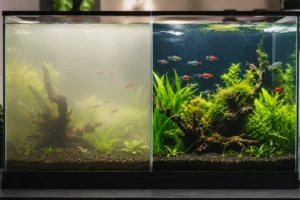
The most important principle is simple: do not judge aquarium water by appearance alone. Water clarity is not the same as water quality. Good aquarium care means understanding which values are urgent, which values are long-term stability markers, and which values only matter in context.
For example, ammonia and nitrite are emergency parameters. Nitrate is usually a long-term accumulation parameter. pH is important, but only makes sense together with KH, CO₂, livestock choice, and ammonia risk. GH affects minerals, shrimp, snails, fish, and plants. Oxygen may not show up on every beginner test strip, but it can determine whether fish breathe normally and whether the biological filter performs well.
Quick Water Parameter Overview
- Ammonia: urgent toxic waste signal; should normally be 0 ppm in stocked tanks.
- Nitrite: incomplete cycle signal; should normally be 0 ppm.
- Nitrate: later waste product; controlled through water changes, plants, and maintenance.
- pH: acidity or alkalinity; stability matters more than chasing 7.0.
- KH: carbonate buffering; helps prevent pH swings and crashes.
- GH: calcium and magnesium minerals; important for fish, shrimp, snails, and plants.
- Temperature: affects metabolism, oxygen demand, and ammonia risk.
- Oxygen: supports fish, shrimp, snails, plants at night, and beneficial bacteria.
- CO₂: important in planted tanks; affects pH and plant growth.
- Source water: your tap or RO water sets the starting chemistry.
What you’ll learn in this lesson
- Which aquarium water parameters matter most
- Which values are emergencies and which are long-term trends
- How ammonia, nitrite, and nitrate connect to the nitrogen cycle
- Why pH should be interpreted together with KH and CO₂
- How GH affects livestock, shrimp, snails, and plant minerals
- Why oxygen and temperature are often underestimated
- How to test aquarium water correctly
- How to read parameter patterns instead of reacting to one number
- How to connect test results to real troubleshooting decisions
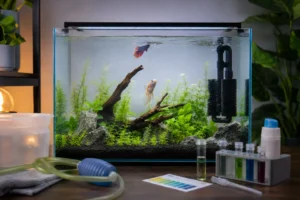
What Are Aquarium Water Parameters?
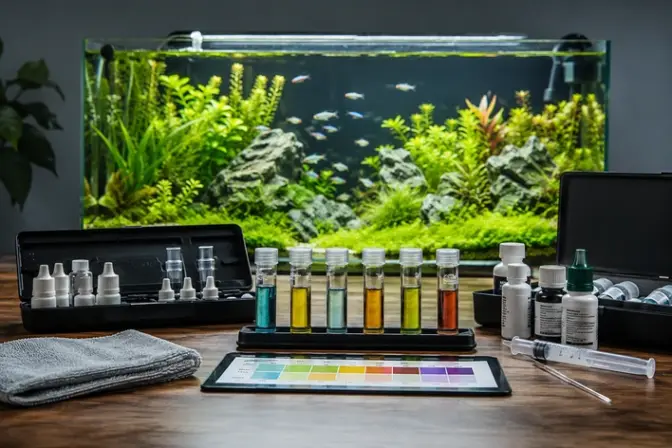
Aquarium water parameters are measurable characteristics of the water. They help you understand whether the aquarium is cycled, stable, oxygen-rich, mineral-balanced, and suitable for the animals and plants you keep.
Some parameters tell you about waste. Ammonia, nitrite, and nitrate show how nitrogen waste is moving through the aquarium. Other parameters tell you about stability. pH, KH, GH, and temperature explain whether the water chemistry is suitable and predictable. Oxygen and CO₂ show how gases behave in the tank, especially in planted aquariums and heavily stocked systems.
The mistake many beginners make is reading each number separately. Aquarium water does not work that way. A pH value means more when you know KH. Ammonia means more when you know pH and temperature. Nitrate means more when you know plant mass, feeding, stocking, and water-change routine.
That is why good water testing is not only about collecting numbers. It is about understanding patterns.
The Most Important Aquarium Water Parameters
The table below gives you a practical overview of the main aquarium water parameters and what each one tells you. Use it as a starting point before going deeper into each section.
| Parameter | What It Measures | Why It Matters | Main Action |
|---|---|---|---|
| Ammonia | Early toxic nitrogen waste | Dangerous to fish and shrimp, especially in unstable or high-pH tanks | Cycle tank, reduce waste, water change if stocked |
| Nitrite | Middle-stage nitrogen waste | Signals incomplete or disrupted biological filtration | Water changes, oxygenation, continue cycling |
| Nitrate | Later-stage nitrogen waste | Accumulation marker and plant nutrient | Water changes, plants, feeding control |
| pH | Acidity or alkalinity | Affects livestock suitability and ammonia risk | Keep stable; avoid sudden correction |
| KH | Carbonate buffering | Controls pH stability and crash risk | Adjust slowly if pH is unstable |
| GH | Calcium and magnesium minerals | Important for fish, shrimp, snails, and plants | Match to livestock and plant needs |
| Temperature | Water warmth | Affects metabolism, oxygen, and ammonia risk | Keep stable and species-appropriate |
| Oxygen | Available dissolved oxygen | Needed by fish, shrimp, snails, and beneficial bacteria | Improve surface movement and flow |
| CO₂ | Dissolved carbon dioxide | Important for planted tanks and pH movement | Balance CO₂ with light, KH, flow, and livestock |
| Chlorine / Chloramine | Disinfectants in tap water | Can harm livestock and biological filtration | Use suitable water conditioner |
Emergency Parameters vs Stability Parameters
Not every water parameter has the same urgency. Some values require immediate action when livestock are present. Others are mainly long-term stability indicators. Understanding this difference helps you avoid panic and focus on the real problem.
Ammonia and nitrite are emergency parameters. In a stocked aquarium, they should normally test at 0 ppm. If either is measurable, especially with fish or shrimp showing stress, act quickly.
Nitrate is usually a long-term accumulation parameter. It can become harmful when high or chronic, but it is usually less urgent than ammonia or nitrite. In planted aquariums, nitrate can also be a nutrient.
pH, KH, GH, temperature, oxygen, and CO₂ are stability and suitability parameters. They explain whether the tank environment matches your livestock and whether the water is likely to swing, crash, or create stress.
| Parameter Group | Examples | Best Interpretation |
|---|---|---|
| Emergency waste | Ammonia, nitrite | Should normally be zero in stocked tanks |
| Accumulated waste | Nitrate | Watch trends, export through maintenance and plants |
| Stability | pH, KH, temperature | Avoid sudden swings and match livestock |
| Mineral balance | GH, calcium, magnesium | Important for shrimp, snails, fish, and plants |
| Gas balance | Oxygen, CO₂ | Important for respiration, plants, and biological filtration |
| Source-water safety | Chlorine, chloramine, tap nitrate | Test and treat before water enters the tank |
Ammonia: The First Emergency Parameter
Ammonia is one of the most important water parameters in freshwater aquariums. It comes from fish waste, uneaten food, dead plants, dead livestock, and decomposing organic matter. In a mature aquarium, beneficial microorganisms convert ammonia into nitrite and then nitrate. In a new or disrupted tank, ammonia can accumulate.
In a stocked aquarium, ammonia should normally test at 0 ppm. Any measurable ammonia should be treated as a warning sign. This is especially important in high-pH and warm aquariums because ammonia becomes more dangerous as pH and temperature increase.
Common causes of ammonia include uncycled tanks, overfeeding, dead livestock, plant melt, filter media replacement, power outages, medication, and sudden overstocking.
If ammonia is measurable, reduce feeding, remove decaying material, perform controlled water changes if livestock are present, increase oxygenation, and protect the filter media. For a full emergency guide, read Ammonia Spike in Aquarium.
Nitrite: The Second Emergency Parameter
Nitrite appears after ammonia begins converting during the nitrogen cycle. It is the middle-stage waste compound between ammonia and nitrate. A nitrite spike often means the first stage of the cycle is working, but the second stage is not mature enough yet.
In a stocked aquarium, nitrite should normally test at 0 ppm. Measurable nitrite means the tank is not fully stable. Fish may gasp, breathe rapidly, clamp fins, become lethargic, or act stressed because nitrite can interfere with oxygen transport.
Nitrite often rises after ammonia drops in new tanks. This is why a tank with 0 ppm ammonia but measurable nitrite is not fully cycled yet. Both ammonia and nitrite must be zero before normal stocking.
If nitrite is present, perform controlled water changes, reduce feeding, increase oxygenation, keep the filter running, and do not add livestock. For the complete guide, read Nitrite Spike in Aquarium.
Nitrate: The Long-Term Waste Parameter
Nitrate is the later-stage product of the nitrogen cycle. In a cycled aquarium, ammonia becomes nitrite, and nitrite becomes nitrate. Nitrate is usually less urgent than ammonia or nitrite, but it still matters because it accumulates over time.
High nitrate usually means waste is being processed but not exported fast enough. Common causes include overfeeding, overstocking, infrequent water changes, dirty substrate, clogged filter debris, low plant uptake, and nitrate already present in tap water.
In planted aquariums, nitrate is also a nutrient. This means zero nitrate is not always the goal. A stable planted tank may intentionally maintain measurable nitrate for plant growth. But nitrate that keeps rising week after week signals an imbalance between waste production and export.
If nitrate is high, test ammonia and nitrite first to rule out urgent problems. Then review water changes, feeding, stocking, plants, and tap water. For details, read High Nitrate in Aquarium.
pH: Acidity, Alkalinity and Stability
pH measures how acidic or alkaline aquarium water is. A pH of 7.0 is neutral, values below 7.0 are acidic, and values above 7.0 are alkaline. Many beginners focus too much on pH because it is easy to test, but pH is only meaningful in context.
For most freshwater aquariums, stable pH is more important than forcing a perfect number. A stable pH of 7.6 may be safer than a tank that swings between 6.5 and 7.8 because of repeated chemical corrections.
pH is connected to KH, CO₂, substrate, rocks, source water, water changes, organic acids, and livestock choice. It also affects ammonia risk: ammonia becomes more dangerous at higher pH and higher temperature if ammonia is present.
For the complete pH framework, read the Aquarium pH Guide. For specific problems, continue with Aquarium pH Too Low, Aquarium pH Too High, and Stable Aquarium pH.
KH: Carbonate Hardness and pH Buffering
KH stands for carbonate hardness and is one of the most important stability parameters in freshwater aquariums. KH helps buffer pH, meaning it helps resist sudden pH changes.
When KH is very low, pH can move more easily. This can be useful in specialized soft-water aquariums, but it also increases the risk of pH swings or crashes if the tank is not managed carefully. When KH is higher, pH usually becomes more resistant to change, but also harder to lower.
This is why pH should almost always be tested together with KH. pH tells you where the water is right now. KH tells you how easily that pH may move.
KH matters especially in planted tanks with CO₂, shrimp tanks, active-soil aquascapes, RO-water systems, and aquariums where pH keeps changing after water changes.
GH: General Hardness and Mineral Balance
GH stands for general hardness. It mainly reflects dissolved calcium and magnesium in the water. GH is different from KH. KH is about buffering and pH stability. GH is about mineral content.
GH matters for fish osmoregulation, shrimp molting, snail shell health, and plant nutrient availability. Shrimp and snails are especially sensitive to mineral balance. Very soft water may be unsuitable for many snails, while very hard water may be unsuitable for some soft-water fish or specialized shrimp species.
Plants also use minerals such as calcium and magnesium. If GH is extremely low or imbalanced, some plants may show deficiency symptoms even when light and CO₂ are good.
When using reverse osmosis water, GH usually needs to be rebuilt with suitable remineralization. Pure RO water is not automatically safe for aquarium use because it lacks stable minerals.
Temperature: More Than Just Comfort
Temperature is often treated as a simple livestock comfort parameter, but it affects the whole aquarium system. Temperature influences fish metabolism, oxygen demand, plant growth, bacterial activity, and ammonia risk.
Warmer water usually holds less oxygen and increases the metabolism of fish and bacteria. This means fish may need more oxygen while less oxygen is available. In warm high-pH aquariums, ammonia can also become more dangerous if ammonia is present.
Stable temperature matters. Sudden swings can stress fish and shrimp, especially after water changes or during seasonal heat waves. A heater should not only reach a target temperature; it should keep the tank stable.
For practical planning, temperature should always be interpreted together with oxygen, stocking, species needs, and room conditions.
Oxygen: The Invisible Survival Parameter
Oxygen is one of the most important but most underestimated aquarium water parameters. Fish, shrimp, snails, and beneficial bacteria all need oxygen. Plants produce oxygen during photosynthesis, but they also consume oxygen at night.
Low oxygen can cause fish to gasp at the surface, breathe rapidly, gather near filter outlets, become lethargic, or die suddenly. Oxygen problems are more likely in warm water, overstocked tanks, dirty tanks, tanks with poor surface movement, bacterial blooms, or aquariums with too much decomposing organic matter.
Oxygen also supports biological filtration. Nitrifying organisms need oxygen-rich flow to process ammonia and nitrite efficiently. A clogged filter, low surface movement, or power outage can therefore affect both livestock and the nitrogen cycle.
To improve oxygen, increase surface movement, clear blocked flow, reduce organic waste, avoid overstocking, and use an air stone during emergencies. A dedicated Aquarium Oxygen Levels article should cover this in more detail once published.
CO₂: Carbon, pH and Planted Tanks
CO₂ is most important in planted aquariums. Plants use carbon for growth, and CO₂ injection can dramatically improve plant performance in high-light aquascapes. But CO₂ also affects pH and livestock safety.
When CO₂ dissolves in water, it can lower pH. In a CO₂-injected planted tank, pH often drops during the photoperiod and rises again after CO₂ turns off. This daily movement can be normal if controlled and if fish are not stressed.
Too much CO₂ or poor gas exchange can make fish gasp, gather at the surface, or become stressed. This is not simply a “low pH” problem. It is a CO₂ and oxygen balance problem.
For full setup guidance, read the Aquarium CO₂ System Guide.
Chlorine and Chloramine
Chlorine and chloramine are disinfectants used in many tap water supplies. They help make drinking water safer for people, but they can harm aquarium livestock and biological filtration if untreated water is added directly to the tank.
For most aquariums using treated municipal tap water, a suitable water conditioner is essential. Follow the product instructions and dose for the water being added. This is especially important during water changes, new tank setup, emergency water changes, and filter maintenance.
Chloramine can be more persistent than chlorine and may require a conditioner that specifically handles it. If your tap water treatment method is unclear, check your local water supplier or use a conditioner designed for both chlorine and chloramine.
Source Water: Tap Water, RO Water and Rainwater
Your aquarium water starts with your source water. Tap water, reverse osmosis water, and rainwater all behave differently. Before adjusting an aquarium, test the water you put into it.
Tap water may be soft or hard, acidic or alkaline, nitrate-free or nitrate-containing. Reverse osmosis water is low in minerals and needs remineralization for most aquarium uses. Rainwater can be variable and may carry pollutants depending on collection method and location.
For many aquarists, stable conditioned tap water is the easiest and safest starting point. Advanced setups may use RO water to control KH, GH, and pH more precisely, but this requires consistent preparation.
Source water testing checklist
- Tap water pH immediately after drawing
- Tap water pH after resting
- Tap water KH
- Tap water GH
- Tap water nitrate
- Temperature before water changes
- Prepared RO-water KH and GH
- Any chlorine or chloramine treatment needs
How Often Should You Test Aquarium Water?
Testing frequency depends on the age and stability of the aquarium. New tanks need more testing because ammonia and nitrite can change quickly. Mature stable tanks may need less frequent testing, but testing should increase after problems or major changes.
| Situation | What to Test | How Often |
|---|---|---|
| New aquarium cycling | Ammonia, nitrite, nitrate, pH | Frequently until cycled |
| After adding fish | Ammonia and nitrite | Several times during the first week |
| Mature stable tank | Nitrate, pH, KH/GH as needed | Weekly to monthly depending on stability |
| Fish stress or deaths | Ammonia, nitrite, pH, temperature, oxygen clues | Immediately |
| Shrimp tank | pH, KH, GH, nitrate, temperature | Regularly and before major changes |
| CO₂ planted tank | pH, KH, CO₂ pattern, nitrate, nutrients | Regularly while tuning |
| After filter cleaning | Ammonia and nitrite | Within the next days |
| After water-source change | pH, KH, GH, nitrate | Before and after use |
How to Read Aquarium Test Results
Reading aquarium test results correctly means looking at relationships, not just numbers. A nitrate result means little without knowing feeding, stocking, plants, and water-change routine. A pH result means little without KH. Ammonia means more when pH and temperature are known.
The safest method is to record results over time. A single test tells you what the tank was like at that moment. A trend tells you where the tank is going.
Better questions to ask
- Is ammonia or nitrite present?
- Is nitrate rising between water changes?
- Is pH stable at the same time of day?
- Is KH high enough for stable pH?
- Does GH match livestock needs?
- Did the value change after adding fish, cleaning the filter, or changing water?
- Are fish, shrimp, snails, or plants showing symptoms?
- Does tap water explain the aquarium result?
Do not change multiple things at once if you can avoid it. If you adjust pH, change water source, clean the filter, add fish, and alter feeding in the same week, it becomes difficult to know what caused the result.
Common Water Parameter Mistakes
Most parameter problems become worse when aquarists react to numbers without understanding context. Avoid these common mistakes.
- Judging water by appearance: clear water can still contain ammonia or nitrite.
- Testing only pH: pH should be interpreted with KH, GH, CO₂, and livestock needs.
- Ignoring ammonia and nitrite: these are emergency parameters in stocked tanks.
- Chasing perfect pH: repeated correction often creates instability.
- Ignoring tap water: source water may explain nitrate, pH, KH, and GH.
- Replacing all filter media: this can cause ammonia or nitrite spikes.
- Overfeeding: food becomes waste and eventually nitrate.
- Using RO water without remineralization: pure RO lacks stable minerals and buffering.
- Changing too many variables at once: this makes troubleshooting harder.
- Not recording trends: patterns matter more than one isolated test.
Water Parameters Troubleshooting Table
Use this table when a test result looks wrong and you need to decide what to check next.
| Problem | Likely Meaning | First Action |
|---|---|---|
| Ammonia present | Uncycled tank, waste overload, filter disruption | Water change if stocked, reduce waste, protect filter |
| Nitrite present | Cycle incomplete or disrupted | Water change, oxygenation, continue cycling |
| Nitrate high | Waste is accumulating | Water changes, reduce feeding, test tap water |
| pH too low | Low KH, active soil, CO₂, organic acids | Test KH before adjusting |
| pH too high | Hard tap water, high KH, carbonate rocks | Test KH/GH and source water |
| pH swings | Low KH, source-water mismatch, CO₂ instability | Compare tank and tap water |
| GH too low | Low mineral water or RO water | Remineralize appropriately |
| GH too high | Hard water, mineral additives, rocks | Review source water and materials |
| Fish gasping | Low oxygen, ammonia, nitrite, CO₂ excess | Test waste parameters and improve aeration |
| Shrimp deaths | Ammonia, nitrite, mineral instability, parameter swing | Test ammonia, nitrite, pH, KH, GH, temperature |
Aquarium Water Parameters Checklist
Use this checklist when setting up a new aquarium, troubleshooting livestock stress, or preparing for water changes.
- Is ammonia 0 ppm?
- Is nitrite 0 ppm?
- Is nitrate controlled and predictable?
- Is pH stable from week to week?
- Does KH support pH stability?
- Does GH match fish, shrimp, snails, and plants?
- Is temperature stable?
- Is there enough oxygen and surface movement?
- Does source water match the aquarium’s needs?
- Is tap water treated for chlorine or chloramine?
- Have recent changes affected the filter, substrate, feeding, or livestock load?
- Are you recording trends instead of reacting to single results?
Quick Takeaways
- Aquarium water parameters explain whether the tank is safe, stable, and suitable.
- Clear water does not mean healthy water.
- Ammonia and nitrite are emergency parameters and should normally be 0 ppm.
- Nitrate is usually a long-term accumulation parameter and plant nutrient.
- pH should be interpreted together with KH, CO₂, livestock, and ammonia risk.
- KH controls buffering and helps prevent pH swings.
- GH reflects mineral balance and matters for shrimp, snails, fish, and plants.
- Temperature affects oxygen demand and ammonia risk.
- Oxygen supports livestock and biological filtration.
- Source water sets the starting point for every aquarium.
- Testing trends is more useful than reacting to one isolated number.
- Stable aquariums are managed through patterns, not panic.
Conclusion
Aquarium water parameters are the language of aquarium stability. They tell you whether the tank is cycled, whether waste is under control, whether pH is stable, whether minerals match livestock needs, and whether the system is safe for fish, shrimp, snails, plants, and beneficial bacteria.
The most important values for beginners are ammonia and nitrite, because they indicate urgent danger in stocked aquariums. Nitrate, pH, KH, GH, temperature, oxygen, CO₂, and source water then help you understand long-term stability and suitability.
From here, continue with the Aquarium Water Guide for the full water system, the Aquarium Cycling Guide for new tanks, the Aquarium pH Guide for pH stability, or the dedicated problem guides for Ammonia Spike, Nitrite Spike, and High Nitrate.
Next step:
Test your aquarium water and write down ammonia, nitrite, nitrate, pH, KH, GH, and temperature. Then compare the result with your source water. The pattern will tell you much more than one isolated number.
💬 Join the Conversation
Tag us on Instagram @AquariumLesson — we’d love to see your water test results, planted tanks, and aquarium stability routines.
👉 Which aquarium water parameter confused you most when you started: ammonia, nitrite, nitrate, pH, KH, GH, CO₂, or oxygen?
FAQ
What are the most important aquarium water parameters?
The most important aquarium water parameters are ammonia, nitrite, nitrate, pH, KH, GH, temperature, oxygen, CO₂, and source water quality. Ammonia and nitrite are the most urgent in new or unstable tanks.
What should ammonia be in an aquarium?
In a stocked freshwater aquarium, ammonia should normally be 0 ppm. Any measurable ammonia should be treated as a warning sign, especially if fish or shrimp are stressed.
What should nitrite be in an aquarium?
Nitrite should normally be 0 ppm in a cycled aquarium. Measurable nitrite means the nitrogen cycle is incomplete, disrupted, or overloaded.
Is nitrate always bad?
No. Nitrate is less urgent than ammonia or nitrite and can be a plant nutrient in planted aquariums. However, nitrate should not accumulate endlessly and should be controlled through water changes, plants, feeding control, and maintenance.
What is a good pH for a freshwater aquarium?
A good pH depends on your livestock. Many freshwater aquariums work well near neutral to moderately alkaline water, while soft-water fish and some shrimp setups may prefer lower pH. Stability matters more than chasing one universal number.
What is the difference between KH and GH?
KH is carbonate hardness and helps buffer pH. GH is general hardness and reflects minerals such as calcium and magnesium. KH affects pH stability, while GH affects mineral balance for fish, shrimp, snails, and plants.
Why does pH change in aquariums?
pH can change because of low KH, CO₂ injection, active soil, water changes, rocks, substrate, driftwood, organic waste, source water differences, or repeated pH-adjusting products.
How often should I test aquarium water?
Test frequently during cycling, after adding fish, during livestock stress, and after major changes. Mature stable tanks can usually be tested less often, but nitrate, pH, KH, and GH should still be monitored as part of routine care.
Why are fish gasping if water looks clear?
Fish may gasp because of low oxygen, ammonia, nitrite, high temperature, excess CO₂, or poor flow. Clear water does not prove that oxygen or waste parameters are safe.
Should I test tap water?
Yes. Tap water sets the starting chemistry for your aquarium. Test tap water pH, KH, GH, and nitrate so you know whether source water is contributing to aquarium parameter problems.
New to AquariumLesson? Start with our complete Aquarium Lessons Hub or return to the homepage at AquariumLesson.com.
References
- U.S. Environmental Protection Agency. Aquatic Life Criteria – Ammonia.
- FAO. Environment and Fish Health: Water Quality for Aquaculture.
- University of Missouri Extension. Water Quality for Fish Culture.
- North Central Regional Aquaculture Center. An Introduction to Water Chemistry in Freshwater Aquaculture.
- AquariumLesson. Aquarium Water Guide.
Start building your aquarium in My Aquariums
Save this lesson and keep the relevant water targets available for your aquarium.